Entry-Level vs High-Volume Card Printers: Which Is Right?
Table of Contents []
- Choosing Between Entry-Level vs High-Volume Card Printers: What Plastic Card ID Wants You to Know First
- Entry-Level Card Printers: Built for Focused, Low-Volume Programs
- Mid-Range Card Printers: The Workhorses Most Businesses Actually Need
- High-Volume and Industrial Card Printers: When Scale Demands More
- Ribbons, Consumables, and the Total Cost of Card Printing
- Buyer's Guide: How to Match Your Program to the Right Printer
- Get the Right Card Printer from Plastic Card ID Today
Choosing Between Entry-Level vs High-Volume Card Printers: What Plastic Card ID Wants You to Know First
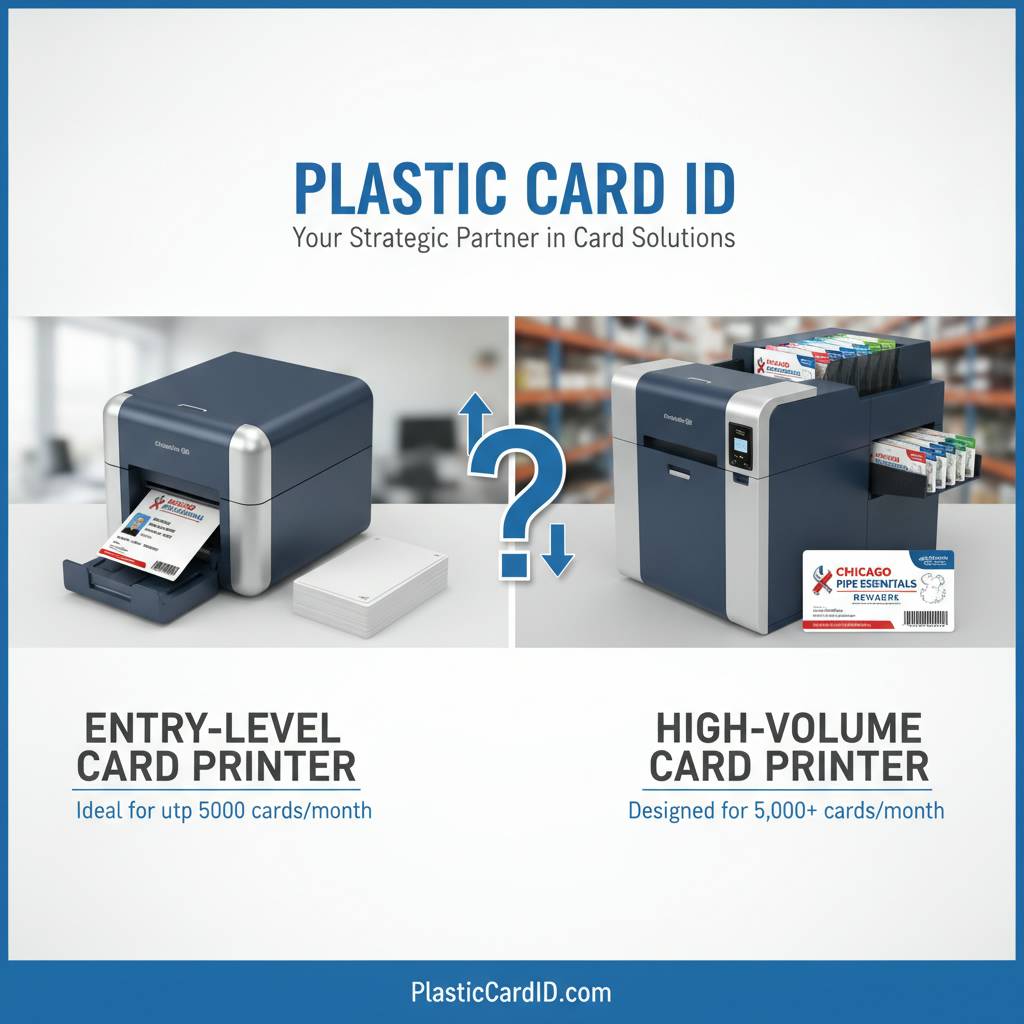 Most buyers come to us knowing they need a card printer - but not always knowing which tier of printer actually fits their operation. That disconnect costs businesses money, time, and frustration. The difference between printing 200 employee badges a year and producing 4,000 access control cards per month is enormous, and treating those two scenarios as interchangeable leads to either overspending or under-equipping your team.
The entry-level vs high-volume card printer decision is not simply about price. It is about throughput, duty cycles, ribbon efficiency, encoding capability, and the realistic day-to-day demands of whoever is managing your card program. At Plastic Card ID, we have helped more than 100,000 businesses across the United States navigate exactly this decision - and we have seen what happens when organizations get it right, and when they do not.
This guide breaks down the full landscape clearly. Whether you are running a small gym printing 50 membership cards a month or a university churning through thousands of student IDs before semester start, the right printer exists for your needs - and we will help you find it.
Why This Decision Matters More Than You Think
A printer that is technically capable of producing your cards is not the same as a printer that is built for your production volume. Entry-level units are designed with specific duty cycles - push them beyond those limits and you will see premature ribbon waste, mechanical wear, and more frequent cleaning cycles than your team bargained for.
Conversely, purchasing a high-volume industrial printer for a small HR department printing a few hundred cards annually is a significant overinvestment. You pay more upfront, consume more consumables per small run, and frankly operate machinery that was engineered for a workload you may never reach. The goal is a precise match, not a vague approximation.
Volume Tiers: A Practical Framework
Think in concrete annual and monthly numbers. Organizations printing fewer than 1,000 cards per year sit comfortably in the entry-level category. Those producing between 1,000 and 6,000 cards per month belong in the mid-range. Anything beyond that - think large corporate campuses, hotel chains, healthcare networks - requires a high-throughput solution engineered for sustained industrial output.
These tiers are not arbitrary. They reflect real engineering specifications: input hopper capacities, print head longevity, ribbon yields, and motor tolerances. CPE aligns every printer recommendation directly to these benchmarks - not to margins or inventory convenience.
The Hidden Costs of Getting It Wrong
Buying too small means ribbons running out mid-batch, slower per-card print times that bottleneck your staff, and the very real possibility of burning through a desktop unit in under two years. Buying too large means capital tied up in hardware that sits idle, plus consumable costs calibrated for volume you never reach.
The smartest investment is the one that scales to your actual program - with just enough headroom for growth, not a surplus you will never use. That is the calculation Plastic Card ID performs with every customer who calls us before purchasing.
| Volume Category | Cards Per Year | Recommended Tier | Example Models |
|---|---|---|---|
| Low Volume | Under 1,000/year | Entry-Level Desktop | Evolis Badgy200 |
| Mid Volume | 1,000-72,000/year | Mid-Range Workhorses | Evolis Zenius, Primacy2 |
| High Volume | 72,000/year | Industrial/High-Throughput | Evolis Agilia, Matica Event Printer |
| Security ID Programs | Variable | Security-Focused | Fargo, Zebra Series |
Entry-Level Card Printers: Built for Focused, Low-Volume Programs
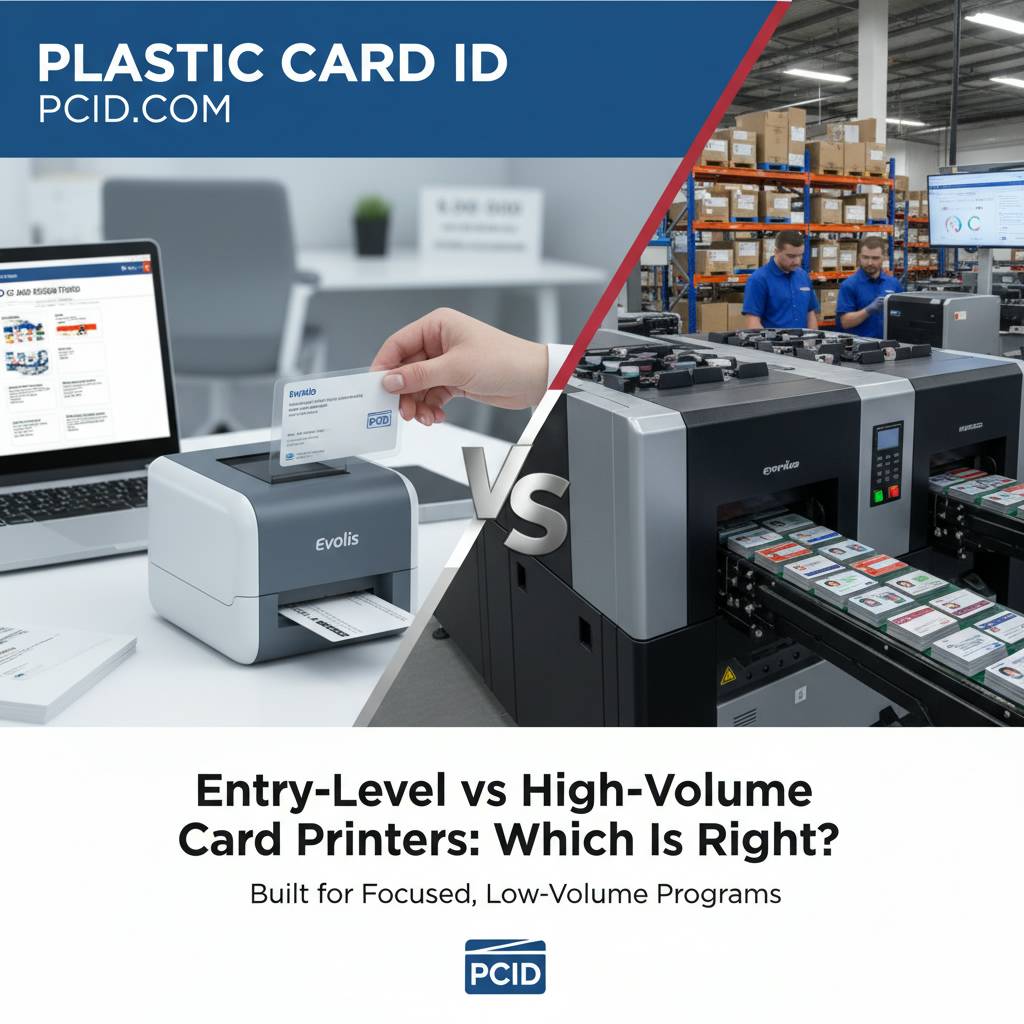 Entry-level does not mean low quality. It means purpose-built efficiency for programs that do not require industrial throughput. The Evolis Badgy200 is a precise example of this philosophy - a compact, professional-grade unit engineered for organizations printing under 1,000 cards per year, delivering clean, full-color output without the complexity or cost of a larger system.
Small businesses, community organizations, local schools, and boutique fitness studios all fall into this category. Their needs are real and their standards are professional - they simply do not require the horsepower of a mid-range or industrial unit. Getting them into the right equipment means faster ROI and a simpler operational footprint.
What Entry-Level Printers Do Well
Desktop entry-level printers are compact, straightforward to operate, and require minimal setup. Staff training is minimal. Ribbon installation is simple. Card loading is intuitive. For small teams without a dedicated IT or facilities department, this simplicity is genuinely valuable - not a limitation.
Print quality on entry-level models from Evolis is still professional-grade. Full-color YMCKO ribbon output produces crisp logos, clean text, and accurate photos on standard PVC cards - results that look entirely professional on an ID badge, membership card, or event credential.
Realistic Limitations to Understand Upfront
Entry-level printers typically have smaller input hoppers - often 25-50 cards - which means manual reloading for larger batch jobs. Print speeds are slower, typically in the range of 150-300 cards per hour for single-sided color output. These are engineering tradeoffs built into the price point, not defects.
Encoding options on entry-level models are often available as upgrades rather than standard features. Magnetic stripe encoding, smart chip modules, and lamination are typically add-on configurations. CPE can walk you through exactly which upgrades make sense for your specific card program before you commit.
Who Should Choose Entry-Level
If your organization prints employee IDs for a 20-person team once a year, replaces lost badges occasionally, and handles seasonal membership card printing in modest batches, an entry-level printer is the correct investment. Matching the machine to the actual workload is the professional choice.
Contact Plastic Card ID at 800.835.7919 to discuss whether an entry-level model covers your program's current and near-future needs. Our team will not upsell you into equipment you do not require.
Mid-Range Card Printers: The Workhorses Most Businesses Actually Need
Here is the honest truth: the majority of businesses that contact Plastic Card ID land in the mid-range tier. Whether they came in thinking they needed entry-level or assumed they required industrial throughput, most organizations printing 1,000 to 6,000 cards per month find their answer in mid-range models like the Evolis Zenius and Primacy2. These printers are built for sustained daily use without the cost or complexity of full industrial systems.
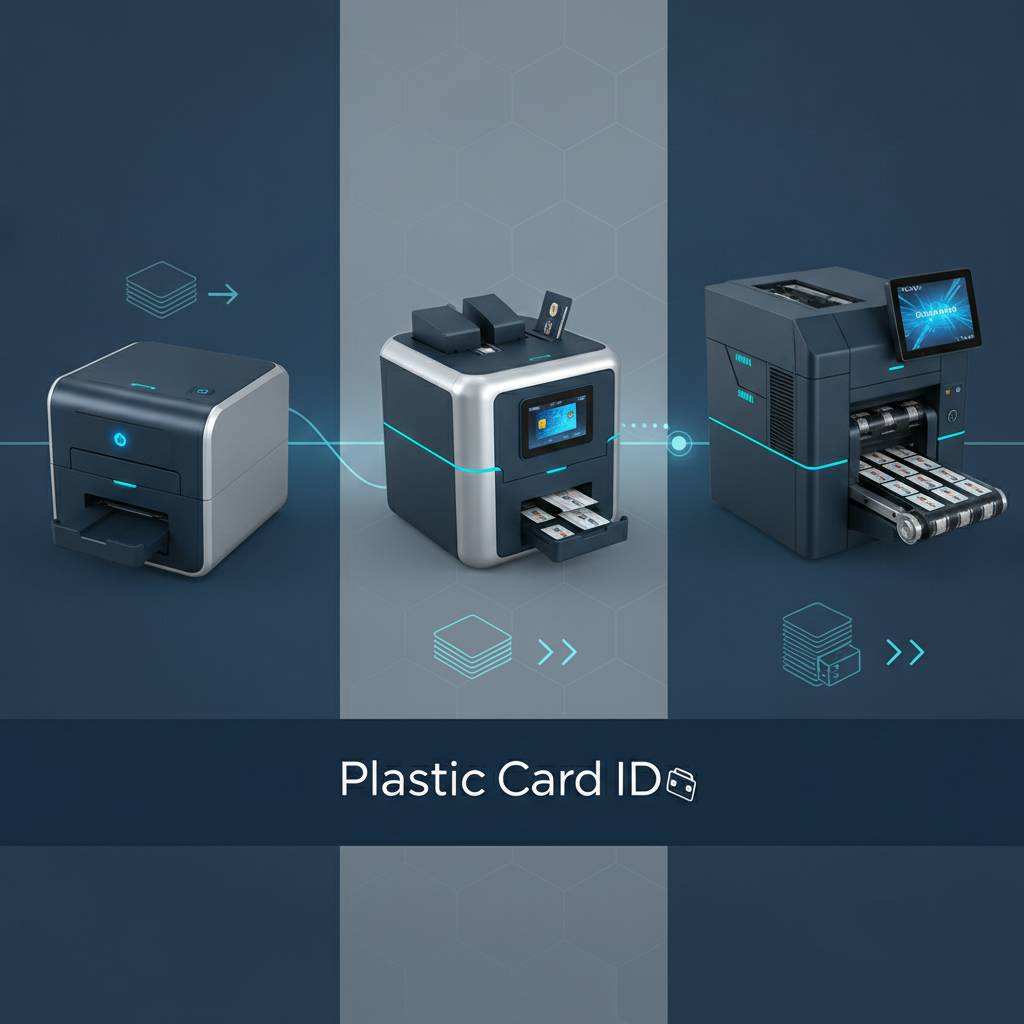
The mid-range tier covers an enormous swath of real-world use cases: corporate HR departments printing new hire IDs weekly, universities issuing student cards at semester start, healthcare networks managing staff credentials across multiple facilities, and retailers running loyalty card programs at scale. These are serious, production-grade machines designed to perform consistently under genuine workloads.
Evolis Zenius: Reliable, Clean, Consistent
The Zenius is a single-sided printer optimized for clear, high-quality card output at volumes that would overwhelm an entry-level unit. It accepts a range of ribbon types including YMCKO for color and monochrome ribbons for black-only text and barcode cards, giving print managers real flexibility in how they run batch jobs.
Throughput on the Zenius is meaningfully faster than entry-level alternatives, and the unit handles longer print sessions without the ribbon waste or mechanical fatigue you would see pushing a desktop printer beyond its intended limits. For organizations with a single primary use case - clean, consistent ID card production - the Zenius delivers reliably.
Evolis Primacy2: Dual-Sided Power for Complex Card Programs
When cards need content on both sides - and most serious ID programs do - the Primacy2 steps in as a dual-sided printing powerhouse. Print employee photos, names, and department details on the front while encoding access tier information, barcodes, or policy text on the reverse. One pass, both sides, no manual flipping required.
The Primacy2 also supports magnetic stripe encoding and smart chip encoding as configured upgrades, making it the printer of choice for access control programs, loyalty card systems, and multi-function ID programs where the card itself carries functional data beyond simple visual identification. This is where mid-range equipment starts delivering industrial-grade capability.
When Mid-Range Outperforms Both Extremes
There is a sweet spot in card printer selection where mid-range hardware delivers the most value per dollar over the lifetime of the equipment. Faster throughput than entry-level without the capital expenditure of industrial-grade systems - that is the mid-range proposition, and for most organizations it holds true.
Mid-range printers from Evolis are also designed with serviceability in mind. Cleaning kits are straightforward to use, ribbon changes are fast, and the overall mechanical design supports the kind of regular maintenance cycles that keep a printer running efficiently for years of sustained operation.
High-Volume and Industrial Card Printers: When Scale Demands More
 Some organizations simply cannot compromise on throughput. A hotel chain issuing thousands of key cards per week. A large university onboarding an entire freshman class in a two-day window. A corporate campus with 10,000 employees spread across multiple buildings requiring badge reprints on demand. These scenarios demand hardware that is built differently - and Plastic Card ID carries it.
The Evolis Agilia and the Matica Event Printer represent the high end of in-house card production capability. These are not scaled-up versions of smaller printers. They are engineered from the ground up for continuous, high-speed output with the mechanical durability to sustain that pace without degradation over time.
Evolis Agilia: Premium Edge-to-Edge Output at Scale
The Agilia delivers edge-to-edge printing with a level of color fidelity and surface coverage that makes it the choice for organizations where card appearance is non-negotiable. Full-bleed designs, sharp photographic output, and consistent color across long production runs are the Agilia's defining strengths.
For security-sensitive programs that require lamination overlay for card durability and visual security features, the Agilia supports lamination module integration - adding a physical protective layer that also increases card lifespan in daily-use environments like access control and employee ID applications.
Matica Event Printer: High-Speed On-Site Badge Production
Event credentialing is a specialized and demanding use case. Thousands of attendees arriving over a narrow window, each requiring a personalized badge, with zero tolerance for bottlenecks at the registration desk. The Matica Event Printer was designed for exactly this scenario - high-speed, on-site, on-demand badge production that keeps lines moving.
Event managers, conference organizers, and large venue operators find the Matica's throughput capabilities essential for maintaining professional registration experiences at scale. When every minute of delay translates to attendee frustration and staff overtime, the right printer is not optional - it is operational infrastructure.
Fargo and Zebra: Security-Focused ID Solutions
Fargo and Zebra printers bring a security-first design philosophy to ID card production. Both brands are widely deployed in government, law enforcement, financial services, and healthcare environments where card integrity, tamper resistance, and secure encoding are baseline requirements.
Contact Plastic Card ID at 800.835.7919 to discuss Fargo and Zebra models in detail. These are not one-size-fits-all printers - they require a conversation about your specific security program requirements, encoding needs, and volume expectations before the right configuration can be recommended.
Ribbons, Consumables, and the Total Cost of Card Printing
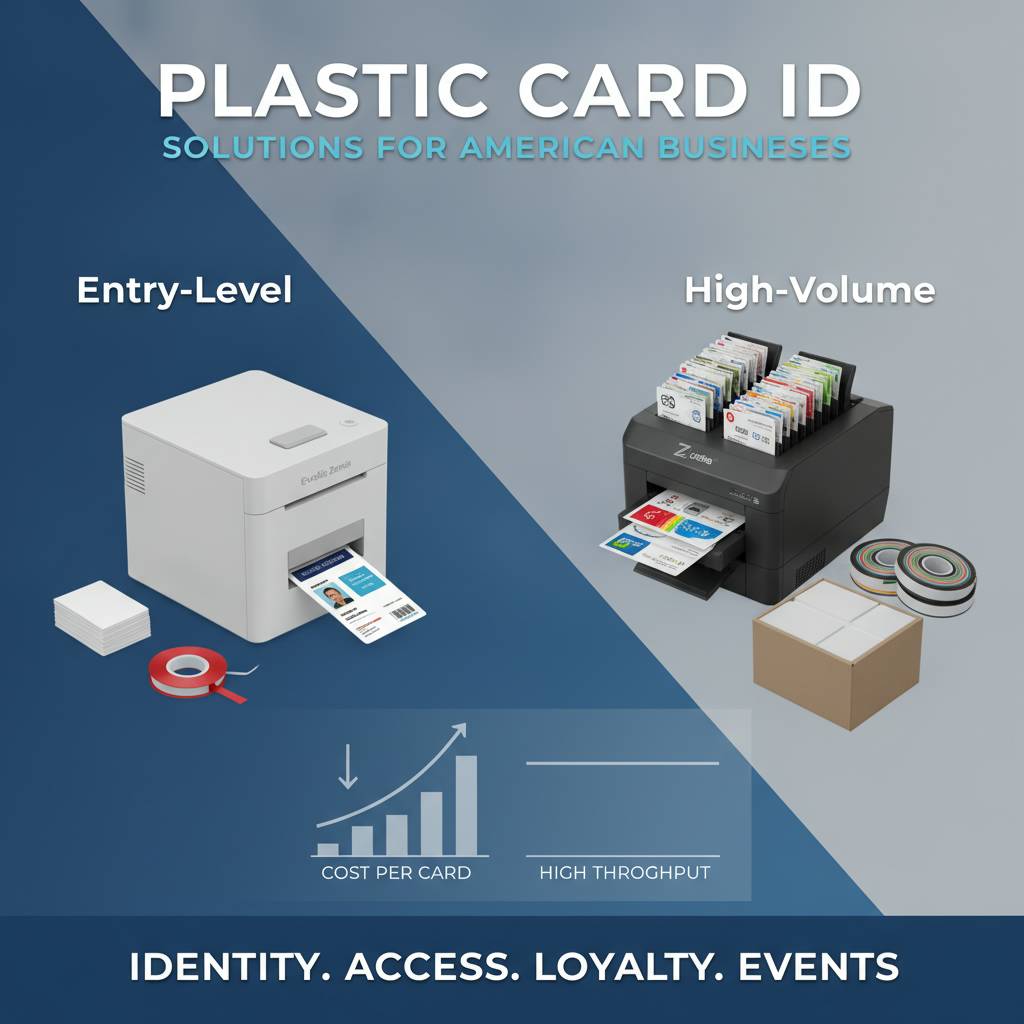 The printer is the beginning of the investment, not the end of it. Every card production program runs on consumables - ribbons, cleaning kits, and in some cases lamination materials. Understanding the true cost-per-card across different ribbon types and printer tiers is essential to making a sound purchasing decision, and it is something Plastic Card ID reviews with every customer who is serious about budgeting their program correctly.
Ribbon yields vary significantly by type. YMCKO color ribbons typically yield 200-500 cards per ribbon depending on the model. Monochrome ribbons - black, white, or metallic - yield substantially more cards per ribbon at a lower cost per print. High-volume programs can dramatically reduce per-card costs by segmenting color and monochrome print runs strategically.
Ribbon Types and When to Use Each
YMCKO ribbons - Yellow, Magenta, Cyan, Black resin, and Overlay - are the standard for full-color card printing with a protective finish layer. They produce the full-color IDs, membership cards, and photo badges that most organizations need. These are the most commonly purchased ribbon type across the customer base.
Monochrome ribbons serve programs that do not require color - think black-text visitor badges, simple access cards, or barcode-only credentials. The cost-per-card on monochrome is significantly lower, and the print speed is faster. For mixed programs, running monochrome on a secondary printer or batch-separating card types can reduce overall ribbon spend meaningfully.
Cleaning Kits: The Maintenance Investment That Protects Everything Else
- Regular cleaning prevents print head contamination that degrades output quality over time
- Cleaning cards and swabs remove dust, debris, and ribbon residue from card transport rollers
- Manufacturer-recommended cleaning intervals vary by printer model and production volume
- Skipping cleaning cycles is the single most common cause of premature print head failure
- Cleaning kits from CPE are model-specific and designed to match each printer's tolerances exactly
The cost of a cleaning kit is negligible compared to the cost of a replacement print head. Treating maintenance as optional is the most expensive decision a card program manager can make. PCID supplies the correct cleaning consumables for every printer model we carry, making it easy to build a proper maintenance schedule from day one.
Encoding Upgrades: Magnetic Stripe, Smart Chip, and More
A card printer that only prints visuals is only half the story for many programs. Magnetic stripe encoding transforms a visual ID into a functional access or loyalty card. Smart chip modules add contactless or contact-based data storage for high-security credential programs. These encoding capabilities are what separate a simple badge from a working card in your organization's systems.
Input hoppers, card carriers, and card sleeves round out the accessories picture - protecting finished cards during distribution, extending card life in high-contact environments, and enabling high-capacity batch loading for production runs that would otherwise require constant manual intervention. Plastic Card ID supplies all of it.
Buyer's Guide: How to Match Your Program to the Right Printer
After 25 years and more than 100,000 customers, the pattern is clear. Most purchasing mistakes fall into one of two categories: underestimating volume growth, or overcomplicating a program that genuinely just needs straightforward card printing. The following framework walks you through the questions that actually determine the right printer for your organization.
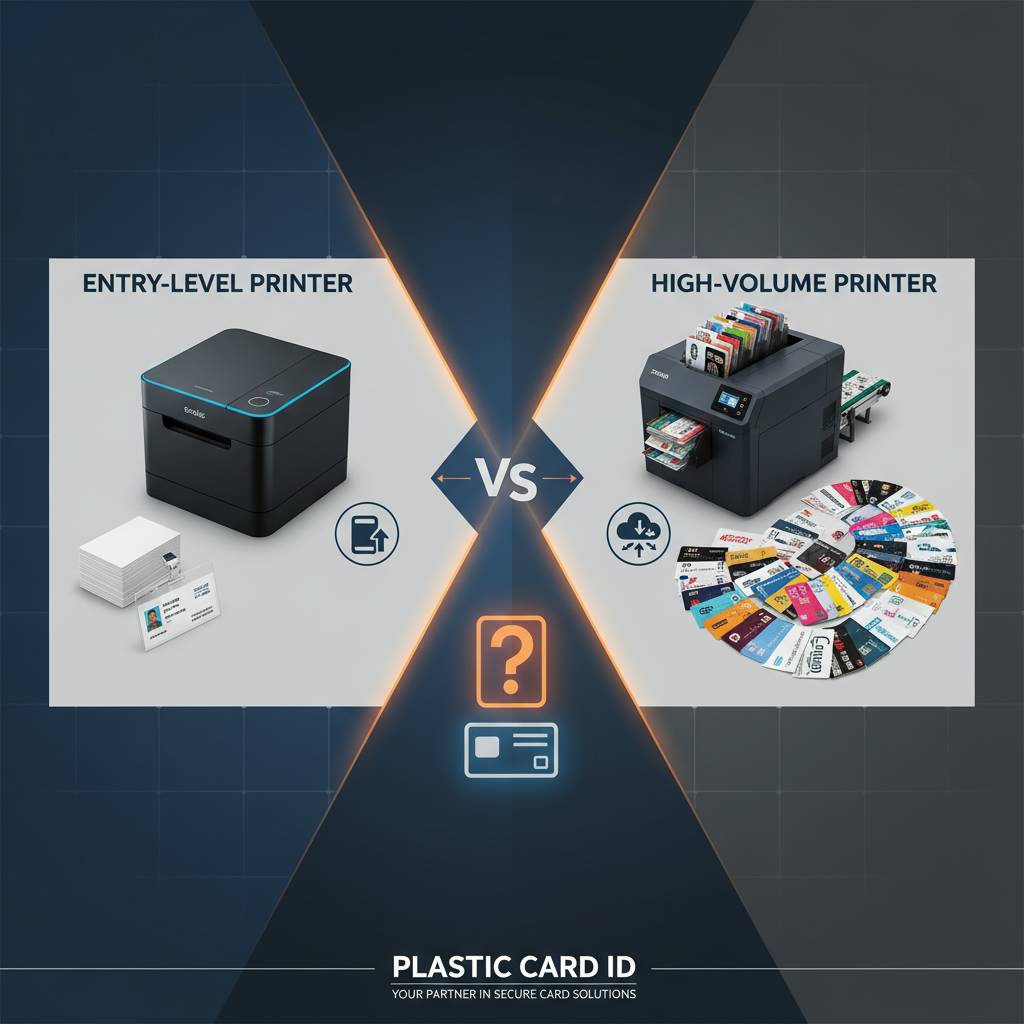
Start with your honest annual card volume - not the theoretical maximum, but the realistic number based on current headcount, turnover rate, program growth expectations, and any seasonal spikes. That number, more than any other single variable, drives the correct purchasing decision.
Key Questions Before You Buy
- How many cards does your organization print per year, and how might that change over the next three years?
- Do your cards need to carry functional data - magnetic stripe, smart chip, barcode, or RFID?
- Is dual-sided printing required, or are single-sided cards sufficient for your program?
- What is your tolerance for per-card production time - do batches need to complete within a specific window?
- Does your team have IT or facilities resources to manage a more complex printer, or do you need something simple and self-contained?
- Are there security requirements - government compliance, healthcare regulations, corporate security standards - that constrain your printer selection?
Working through these questions before reaching out to a vendor saves significant time and avoids the frustration of receiving generic recommendations that do not match your actual situation. CPE is built to have this exact conversation - detailed, specific, and focused entirely on your program's requirements.
Common Card Programs and Their Typical Printer Matches
Employee ID programs for small businesses with under 50 staff typically land in the entry-level or low-end mid-range tier. University student ID programs almost always require mid-range dual-sided capability with magnetic stripe encoding. Hotel key card programs vary enormously depending on property size but frequently require mid-to-high range throughput with smart chip encoding capability.
Membership and loyalty card programs for retailers, gyms, and clubs often start mid-range and scale upward as membership grows. Event credential programs - conferences, trade shows, corporate events - benefit most from the high-speed on-site production capability of the Matica platform. The right answer is always the one that fits your specific scenario, not a general approximation.
Contact Plastic Card ID Before You Finalize Your Decision
A five-minute conversation with our team at 800.835.7919 can confirm your printer selection or redirect you toward a better fit before you commit. We carry entry-level through industrial hardware, supply every category of consumable, and have the experience to recognize the situations where a seemingly obvious choice is actually the wrong one.
With over 25 years in the industry and more than 100,000 customers served, CPE has seen virtually every card program configuration imaginable. That depth of experience translates into faster, more accurate guidance - saving you time, budget, and the headache of discovering a mismatch after installation.
Get the Right Card Printer from Plastic Card ID Today
 The entry-level vs high-volume card printer decision is one of the most consequential choices in building a professional card program - and it is exactly the kind of decision where expert guidance makes a measurable difference. From the compact simplicity of the Evolis Badgy200 to the edge-to-edge industrial output of the Agilia and the event-speed capability of the Matica, the right printer for your program exists in our lineup.
Plastic Card ID supplies the printers, the ribbons, the cleaning kits, the encoding upgrades, the input hoppers, and every accessory your card program needs to run efficiently from day one. We serve businesses across every industry - HR departments, universities, healthcare networks, hotels, retailers, event producers, and more - with the same commitment to matching the right hardware to the right program every time.
Call Plastic Card ID now at 800.835.7919 and let our team help you select the card printer that fits your volume, your use case, and your budget - with no guesswork, no upselling, and no wasted investment.
Previous Page