Direct-to-Card Printing vs Retransfer Printing: Key Differences
Table of Contents []
- Direct-to-Card Printing vs Retransfer Printing: Which Technology Does Your Program Actually Need?
- Understanding Direct-to-Card Printing: The Workhorse of Business Card Programs
- Retransfer Printing Explained: Premium Output for Demanding Applications
- Printer Brands and Models: Matching Technology to Your Operation
- Consumables and Accessories: Keeping Your Card Program Running Smoothly
- Frequently Asked Questions: Direct-to-Card vs Retransfer Printing
- Why In-House Card Printing Gives Your Organization a Real Operational Advantage
- Connect with Plastic Card ID and Build a Card Program That Works
Direct-to-Card Printing vs Retransfer Printing: Which Technology Does Your Program Actually Need?
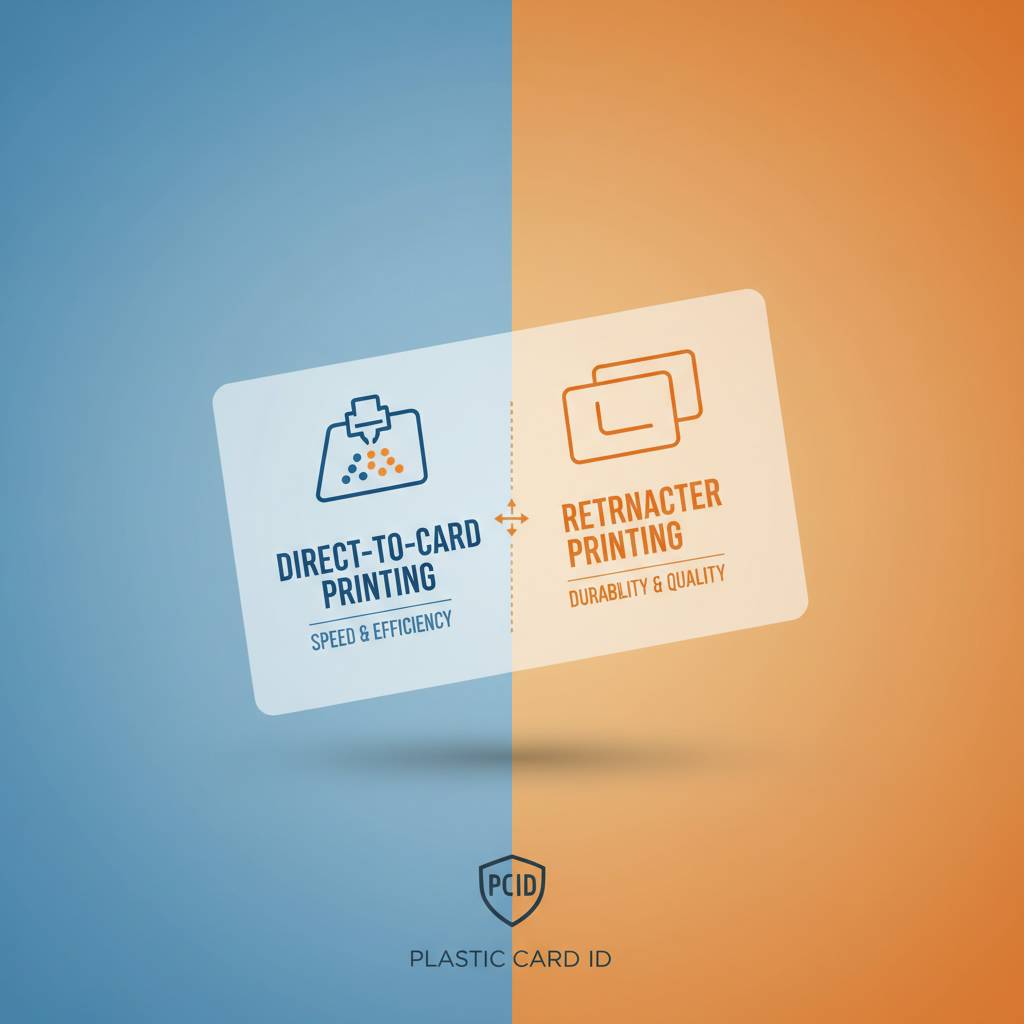 There's a question that comes up constantly in the ID card world, and it deserves a real, thorough answer: should you choose direct-to-card printing or retransfer printing? The wrong choice costs money. The right choice transforms how your organization handles credentials, access cards, employee badges, membership cards, and more. Plastic Card ID has been helping businesses across the United States navigate this exact decision for over 25 years, and the nuance here genuinely matters.
Whether you're outfitting a hospital with staff ID badges, running a university student card program, managing hotel key card issuance, or setting up a loyalty card system for a retail chain, the printing method you select affects card quality, hardware cost, per-card cost, and long-term operational flexibility. Let's break this down clearly so you can make a confident, informed decision.
| Feature | Direct-to-Card (DTC) | Retransfer Printing |
|---|---|---|
| Print Method | Ink transferred directly onto card surface | Image printed on film, then fused to card |
| Edge-to-Edge Printing | Not supported (small white border) | Full edge-to-edge capability |
| Image Durability | Good with topcoat protection | Excellent - film acts as protective layer |
| Compatible Card Types | Standard PVC cards | PVC, PET, smart cards, contactless cards |
| Hardware Cost | Lower upfront investment | Higher upfront investment |
| Per-Card Cost | Lower | Slightly higher (film ribbon) |
| Print Speed | Faster per card | Slightly slower due to two-stage process |
| Best For | Employee IDs, loyalty cards, basic access cards | High-security IDs, government cards, premium credentials |
Understanding Direct-to-Card Printing: The Workhorse of Business Card Programs
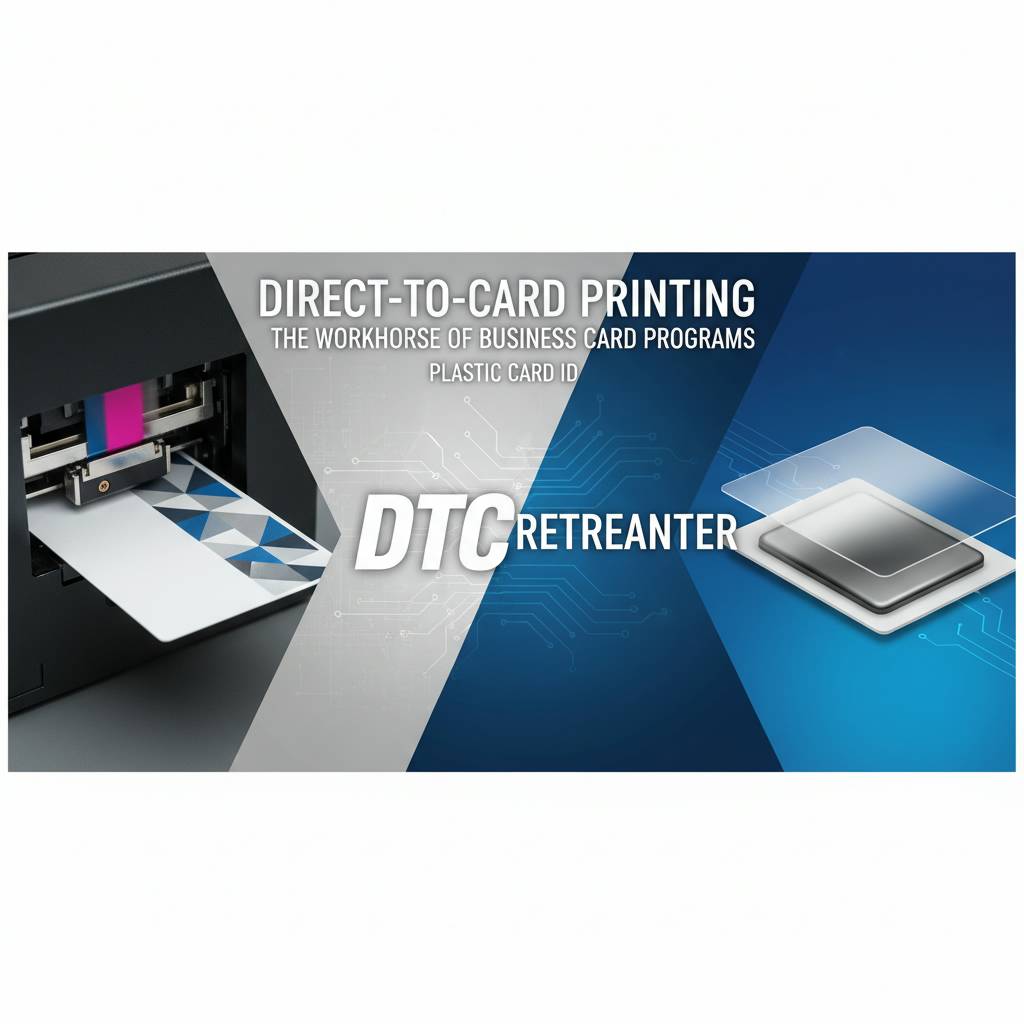 Direct-to-card (DTC) printing is, by a wide margin, the most commonly deployed technology in business card programs across the country. The mechanics are straightforward: a thermal printhead transfers dye from a ribbon directly onto the surface of a PVC card as it passes through the printer. It's fast, cost-effective, and reliable for the vast majority of standard card issuance applications.
What makes DTC so appealing to organizations with moderate printing volumes is the combination of accessible hardware pricing and low per-card consumable costs. Printers like the Evolis Badgy200, Zenius, and Primacy2 all use direct-to-card technology, and they represent some of the most popular units Plastic Card ID supplies to businesses, schools, hospitals, and membership organizations across the United States.
How the DTC Print Process Works
In a direct-to-card printer, a YMCKO ribbon (Yellow, Magenta, Cyan, Black, and Overlay) passes between a thermal printhead and the card surface. Each color panel is applied in sequence. The overlay panel seals and protects the printed image, adding a crucial layer of durability to the finished card. The entire process happens within seconds per card.
The printhead makes direct physical contact with the card surface during printing. This means the card must have a smooth, clean, receptive surface - standard white PVC cards are ideal. Any debris, oils from handling, or surface irregularities can cause print defects, which is why regular printer cleaning using proper cleaning kits is so important for maintaining consistent output quality over time.
The Small But Real Limitation: The White Border
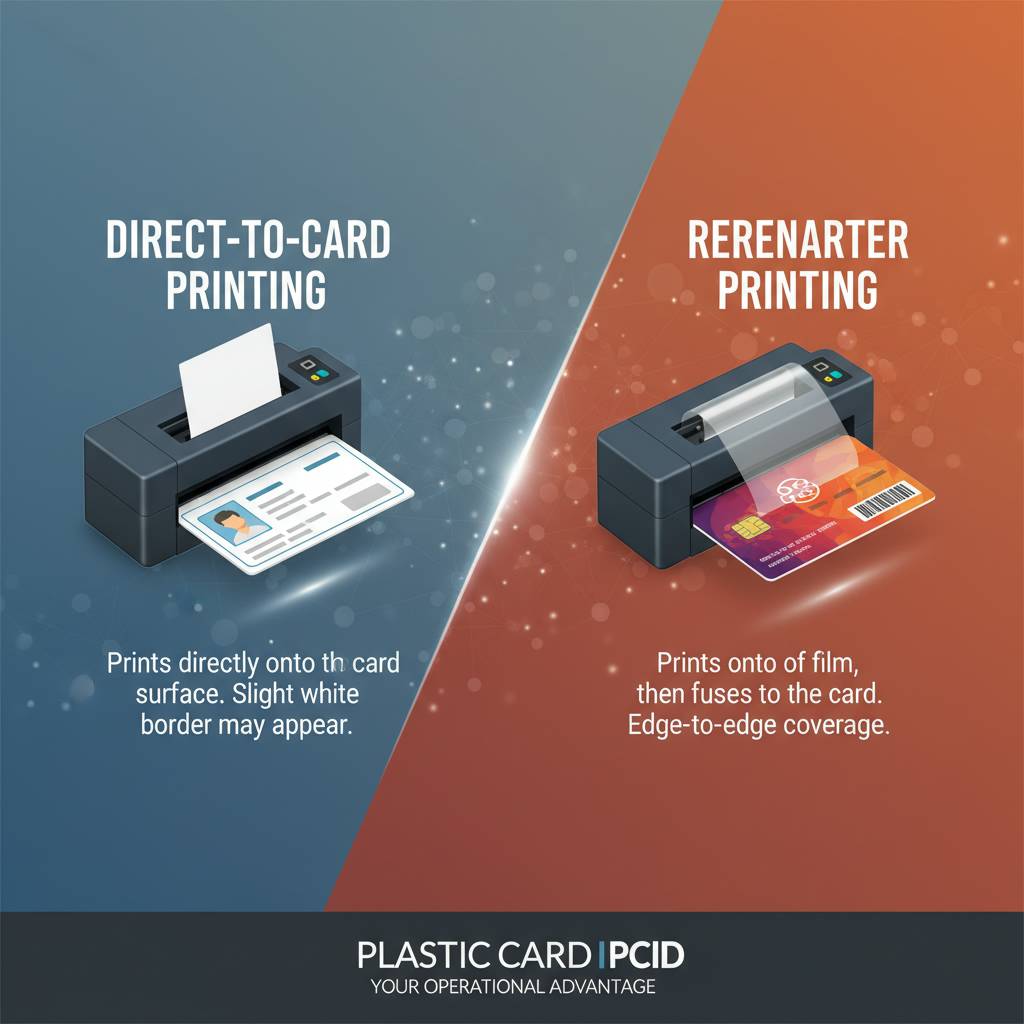
Here's something buyers often discover after the fact: direct-to-card printers cannot print to the absolute edge of a card. A small unprintable border - typically around 1mm on each side - exists because the printhead cannot extend beyond the card's edge without risking damage to the print mechanism. For most card designs, this is a non-issue. Employee badges, membership cards, student IDs, and loyalty cards designed with this in mind look perfectly professional.
However, if your card design includes a full background color or image that extends completely to all four edges, you'll either need to work within the design constraints or look toward retransfer technology. This is one of the most practical differentiators between the two technologies, and it's worth discussing your specific card design requirements before committing to a printer purchase.
Ideal Use Cases for Direct-to-Card Printers
The applications where DTC printing excels are broad. Most organizations find that their card programs fall squarely within the sweet spot of this technology. CPE regularly recommends DTC printers to clients in healthcare, education, hospitality, retail, and corporate environments.
- Employee ID cards with photo, name, title, and barcode
- Loyalty and rewards cards for retail programs
- Student ID cards for schools and universities
- Basic access control cards with magnetic stripe encoding
- Hotel key cards and guest credentials
- Event badges and conference credentials
- Membership cards for clubs and associations
Call 800.835.7919 to speak with an expert who can help match a specific DTC model to your volume, card design, and encoding requirements. The right printer for a 200-card-per-year HR department looks very different from the right printer for a 3,000-card-per-month university enrollment office.
Retransfer Printing Explained: Premium Output for Demanding Applications
Retransfer printing - sometimes called reverse transfer or inkjet retransfer - uses a fundamentally different process than direct-to-card. Instead of printing directly onto the card surface, the image is first printed onto a clear film, which is then thermally bonded (fused) to the surface of the card. The result? A visually superior, extraordinarily durable card image that covers the card completely, edge to edge, with no white border.

The Evolis Agilia is a standout example of a premium retransfer printer in the lineup that Plastic Card ID carries. Designed for organizations that demand the highest visual quality and need true edge-to-edge output, the Agilia represents the top tier of in-house card production capability. It also opens the door to printing on cards with embedded smart chips or contactless antenna arrays - card types whose uneven surfaces would damage a direct-contact DTC printhead.
The Two-Stage Retransfer Process
Stage one: the printer's printhead applies the full-color image onto a retransfer film, which is a clear, flexible carrier material. This happens at a slightly lower temperature than the second stage. Stage two: the film, now bearing the complete card image, is pressed against the card surface using a heated roller that fuses the film permanently and completely to the card. The result is a card image that's actually beneath a protective film layer, making it inherently more resistant to fading, scuffing, and surface wear than a typical DTC-printed card.
Because the printhead never contacts the card itself, retransfer printers can handle cards with slightly irregular surfaces - smart card chips, embedded antennas for contactless cards, and even cards with pre-laminated overlays. This compatibility advantage is significant for organizations running access control programs or government-grade ID systems where smart technology in the card is non-negotiable.
Image Quality and Edge-to-Edge Output
If you've ever held a retransfer-printed card next to a direct-to-card printed card, the visual difference is immediate and pronounced. Colors are richer, edges are crisper, and the surface has a uniform, glass-smooth appearance across the entire card face. For applications where the card itself is a brand statement - premium membership programs, VIP credentials, high-end loyalty cards, or executive ID badges - retransfer printing elevates the product considerably.
Edge-to-edge printing becomes a design liberation rather than a workaround. Full-bleed backgrounds, photography that runs completely to the card edge, and complex gradient designs that would show awkward white borders on a DTC printer all reproduce perfectly with retransfer technology. Designers and marketing teams working on card programs consistently prefer the creative freedom that retransfer output provides.
Cost Considerations for Retransfer Systems
There's no way around it: retransfer printing costs more. Hardware prices are meaningfully higher than comparable-volume DTC printers, and per-card consumable costs are elevated because you're consuming both a color ribbon and the retransfer film for every card produced. The investment makes sense when quality and card compatibility requirements justify it - and for many organizations, they absolutely do.
The key calculation is total cost of ownership against operational need. An organization printing 500 high-security government ID cards per month, each with a smart chip and a full-bleed photo, has very different economics and requirements than a gym printing 50 membership cards per month. CPE helps clients work through this math honestly so the budget allocation makes real-world sense for the application.
| Application Type | Recommended Technology | Suggested Printer Range |
|---|---|---|
| Basic Employee ID Cards | Direct-to-Card | Evolis Badgy200, Zenius |
| High-Volume Membership/Loyalty | Direct-to-Card | Evolis Primacy2, Fargo, Zebra |
| Smart Card / Contactless ID | Retransfer | Evolis Agilia |
| Premium Full-Bleed Credentials | Retransfer | Evolis Agilia, Matica |
| On-Site Event Badging | Direct-to-Card (High Speed) | Matica Event Printer |
Printer Brands and Models: Matching Technology to Your Operation
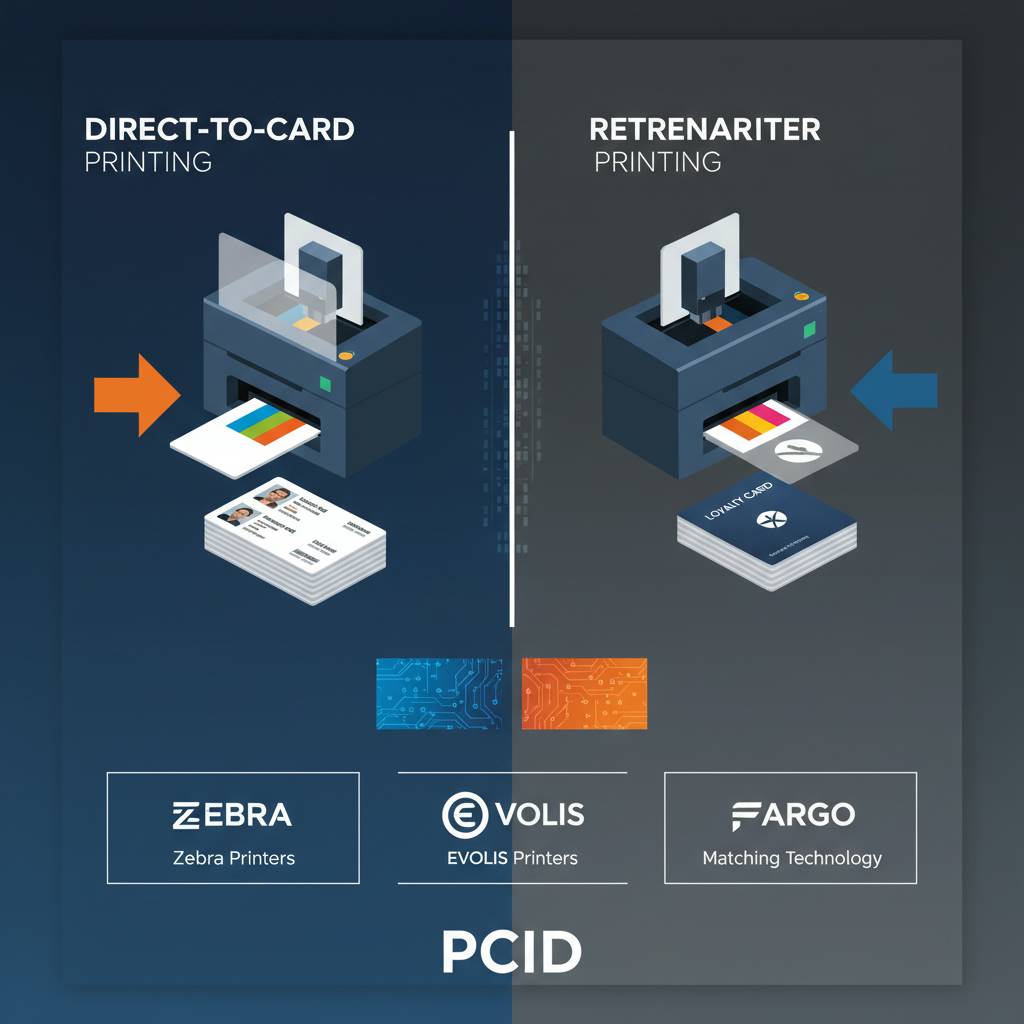 Plastic Card ID carries a deliberately curated selection of card printers rather than every model from every manufacturer. The reasoning is sound: too many choices without clear differentiation helps no one. The brands in the lineup - Evolis, Fargo, Zebra, and Matica - each bring distinct strengths, and the goal is always to match the right tool to the specific operational requirement.
Evolis dominates the entry and mid-range direct-to-card space with models like the Badgy200 (ideal for under 1,000 cards annually), the Zenius and Primacy2 (suited for 1,000 to 6,000 cards per month), and the premium Agilia for retransfer output. Fargo and Zebra printers add robust options particularly well-suited to security-focused ID programs where encoding reliability and hardware durability are non-negotiable. Matica rounds out the lineup with solutions including the Event Printer for organizations that need to process large numbers of badges rapidly on-site.
Entry-Level and Mid-Range DTC: Evolis Badgy200, Zenius, and Primacy2
The Evolis Badgy200 is genuinely one of the most accessible professional card printers available. Designed for organizations that print infrequently but still need professional output, it handles basic ID and membership card printing without the complexity or cost of enterprise-grade systems. Schools, small businesses, nonprofits, and community organizations find it fits their needs perfectly.
The Zenius and Primacy2 step up significantly in both volume capacity and feature availability. Both support dual-sided printing, magnetic stripe encoding, and smart card encoding upgrades - expanding what your card program can accomplish without requiring a switch to retransfer technology. These are the printers that make a mid-sized business's in-house card program genuinely sustainable and scalable. Reach the team at 800.835.7919 to discuss which Evolis model suits your monthly card volume and encoding needs.
Security-Focused Programs: Fargo and Zebra Printers
Fargo and Zebra both have deep roots in identity and access management environments where card integrity is a security requirement, not just an aesthetic preference. These printers are built to handle demanding production environments with higher-duty cycles, more robust card handling mechanisms, and encoding capabilities that support complex access control architectures.
For organizations running enterprise-wide employee ID programs, government agency credentials, or multi-site security card deployments, Fargo and Zebra represent the kind of hardware investment that pays back in reduced downtime, consistent output quality, and compatibility with industry-standard ID management software. CPE can walk through the specific Fargo and Zebra models available and help identify the right specification for your security program.
High-Speed Event Badging: The Matica Event Printer
Event credentialing is a genuinely different animal from ongoing ID card programs. The Matica Event Printer is purpose-built for situations where you need to print and distribute hundreds or thousands of badges quickly, on location, without a production backlog that holds up entry. Speed and reliability under pressure are its defining characteristics.
Conference organizers, trade show managers, sporting event credential teams, and university orientation programs all benefit from having dedicated high-speed event badge printing capability. Pairing the Matica Event Printer with pre-loaded card data and efficient card carriers and sleeves creates a workflow that handles even large-scale credentialing events smoothly and professionally.
Consumables and Accessories: Keeping Your Card Program Running Smoothly
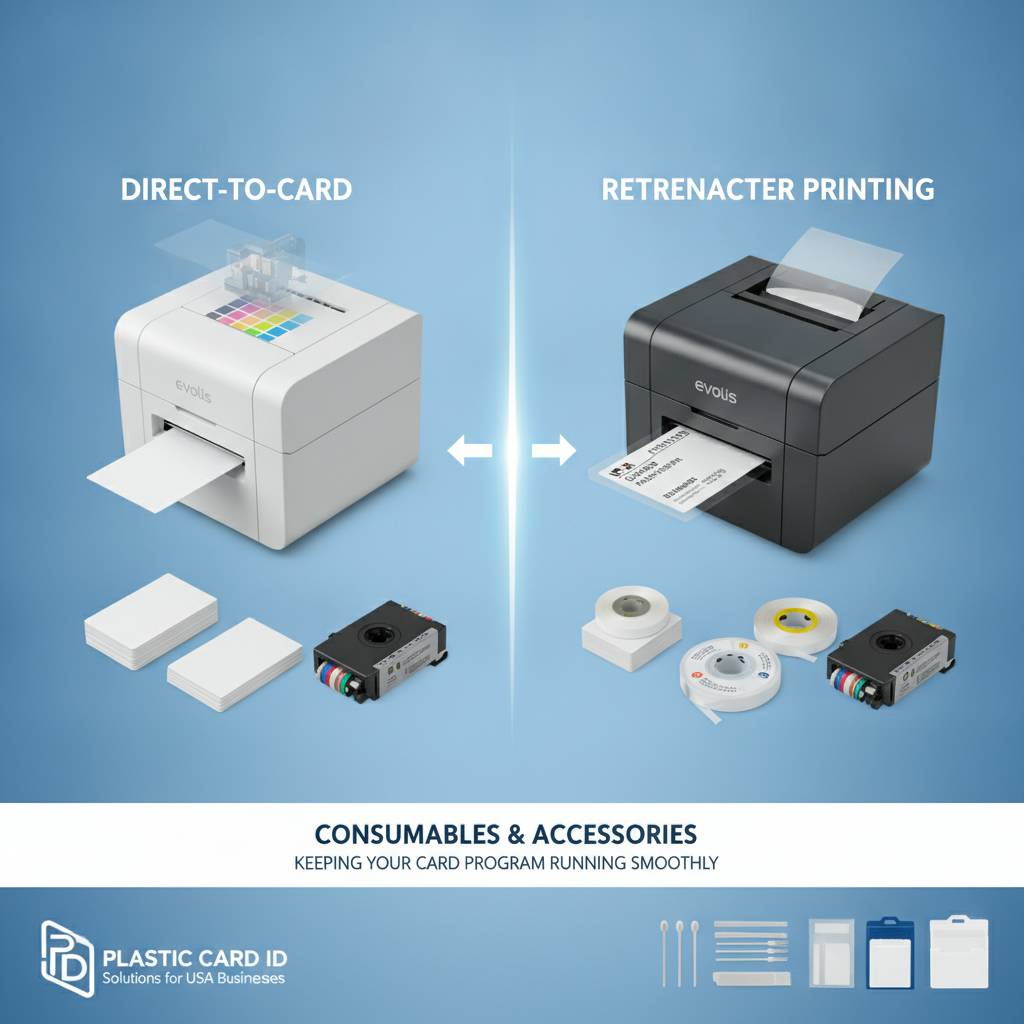 A card printer without the right consumables is just an expensive paperweight. Ribbons, cleaning kits, lamination modules, and encoding accessories are as critical to a functional card program as the printer itself. Plastic Card ID supplies a complete range of consumables for every printer in its lineup, so you're not hunting across multiple vendors to keep your operation stocked.
The ribbon selection alone covers a wide range of output requirements. YMCKO ribbons handle full-color printing with an overlay panel for protection. Monochrome ribbons - black, white, red, blue, gold, silver - serve applications where single-color output is sufficient and cost efficiency matters. Specialty ribbons for metallic effects, UV-reactive security printing, and other applications are also available for programs with specific security or visual requirements.
Ribbons: Choosing the Right Formulation for Your Printer and Output
YMCKO ribbons are the standard choice for full-color card printing, covering most employee ID, membership, and loyalty card applications with excellent results. Each ribbon panel - Yellow, Magenta, Cyan, Black, and the protective Overlay - works together to produce a complete, protected card image. Using the correct manufacturer-specified ribbon for your printer model is essential for consistent print quality and printhead longevity.
Specialty ribbon options open up additional possibilities. KO ribbons (black plus overlay) handle monochrome printing at a lower per-card cost than YMCKO, making them appropriate for basic text-and-barcode applications like simple access cards or internal work order cards. Understanding which ribbon formulation matches your specific output requirement helps control consumable costs without sacrificing print quality where quality genuinely matters.
Cleaning Kits and Maintenance Supplies
Routine printer cleaning is not optional - it's a core maintenance requirement that protects your printhead, prevents print defects, and extends the operational life of your hardware. Most manufacturers specify cleaning cycles by card count, and following those schedules consistently is the single best thing you can do to protect your printer investment.
Cleaning kits typically include cleaning cards, cleaning swabs, and cleaning rollers designed for specific printer models. Some printers include cleaning prompts that remind operators when maintenance is due. Using manufacturer-approved cleaning supplies rather than improvised alternatives protects the sensitive components inside the printer from damage that voids warranties and leads to expensive repairs.
Encoding Upgrades: Magnetic Stripe, Smart Chip, and More
Many direct-to-card printers support optional encoding modules that expand what your cards can do. Magnetic stripe encoding writes data to the magnetic stripe on the back of compatible cards during the print process, enabling the card to function as a key card, loyalty identifier, or access credential. Smart card encoding modules write data to embedded chips, enabling contactless or contact-chip functionality for more sophisticated access control and identity applications.
Lamination modules add an additional layer of protection to finished cards, significantly extending card life in demanding use environments like outdoor access points, high-use membership applications, or cards that are handled repeatedly throughout the workday. Input hoppers increase the card capacity of printers for higher-volume production runs, reducing the need for operator intervention during batch printing jobs. Call 800.835.7919 to learn which encoding and accessory options are compatible with the printer models you're considering.
Frequently Asked Questions: Direct-to-Card vs Retransfer Printing
After 25 years of helping businesses set up and maintain card printing programs, certain questions come up consistently. The answers below reflect real-world experience with both technologies across a wide range of organizational types, volumes, and card design requirements.
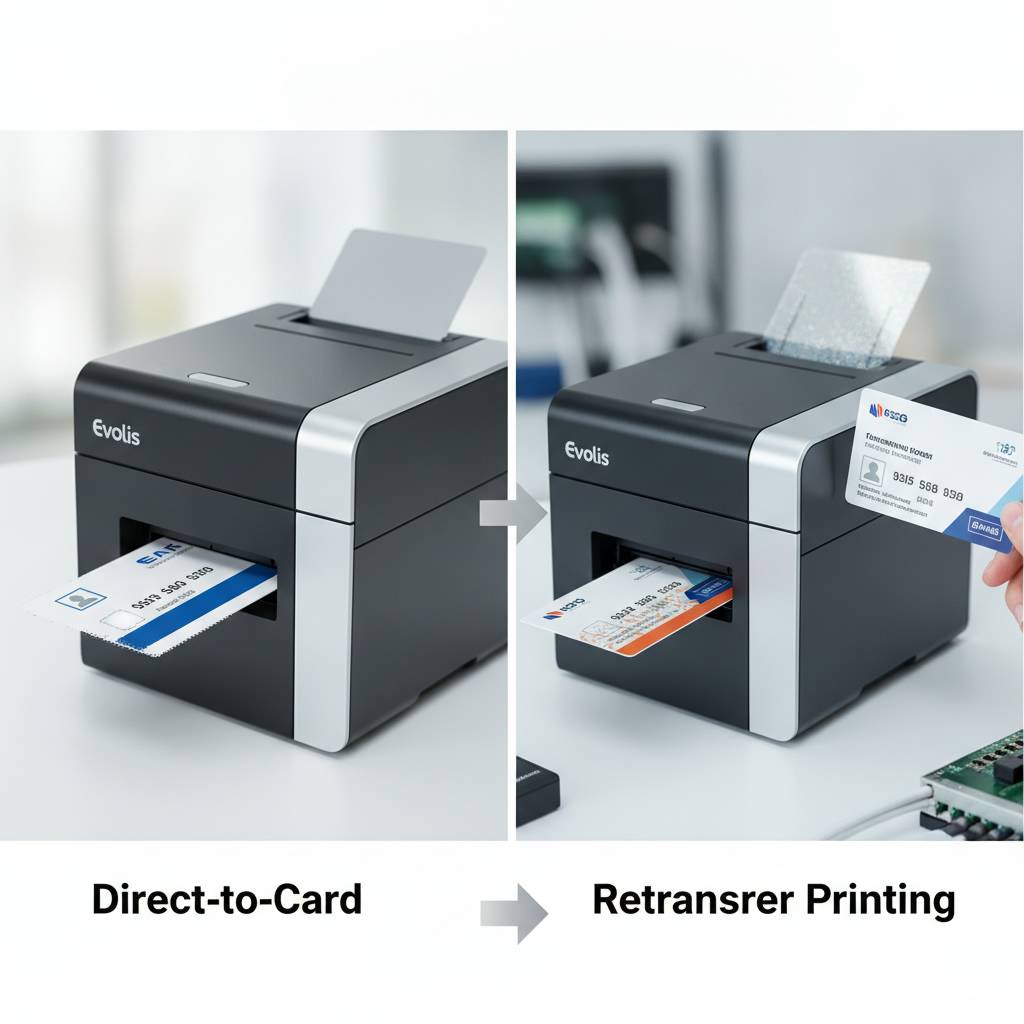
These aren't theoretical edge cases - they're the practical considerations that determine whether a card program runs smoothly or becomes a source of frustration and unexpected cost. Reading through these common questions before making a purchase decision is time well spent.
Can I Switch from DTC to Retransfer Later If My Needs Change?
Generally, no - not with the same hardware. Direct-to-card and retransfer are fundamentally different printer architectures, not software configurations. Upgrading from one technology to the other means purchasing a new printer. This is why getting the initial purchase decision right matters so much, and why it's worth having a real conversation about your anticipated card program growth before committing to hardware.
That said, starting with DTC and later adding a retransfer printer for specific high-quality applications isn't unusual for organizations whose card programs expand over time. Some businesses maintain both technologies simultaneously - using DTC for routine employee ID and access card production while reserving retransfer output for premium credential applications that warrant the higher per-card investment.
Does Retransfer Printing Take Much Longer Per Card?
Yes, slightly. Because the retransfer process involves two distinct thermal stages rather than one, the per-card print time is modestly longer than a comparable DTC printer. For most applications, this difference is not operationally significant. If you're printing a few hundred cards per day, the time difference is negligible. If you're printing thousands of cards daily in a production environment, the throughput comparison becomes a relevant spec to evaluate.
High-end retransfer printers like the Evolis Agilia are engineered to minimize this time difference through optimized thermal management and efficient card transport mechanisms. The quality tradeoff for the modest speed difference is, for the applications that warrant retransfer technology, overwhelmingly positive. Speed-focused applications with basic quality requirements are almost always better served by DTC technology anyway.
What Card Types Work with Each Technology?
Standard white PVC CR80 cards work well with both DTC and retransfer printers, though retransfer will produce superior image quality on the same card stock. The real compatibility advantage of retransfer printing emerges when you need to print on cards with embedded components - smart chips, contactless antennas, or other surface irregularities that would physically damage a DTC printhead through direct contact.
DTC printers require smooth-surfaced cards for consistent print quality. Cards with textured surfaces, raised elements, or pre-applied overlays that create surface variation are not suitable for DTC printing but can often be handled by retransfer systems. If your card program involves any non-standard card types, this compatibility consideration may be the deciding factor in your technology choice.
Why In-House Card Printing Gives Your Organization a Real Operational Advantage
 Outsourcing card production to a third-party print vendor introduces delays, minimum order quantities, security risks around personal data, and complete loss of flexibility for on-demand issuance. In-house printing eliminates every one of those problems simultaneously. An employee starts today - their ID card is printed today. A member joins this morning - their membership card is ready this afternoon. That responsiveness is simply not possible with an outside vendor relationship.
Beyond speed, in-house production gives organizations complete control over card data security. Personnel photos, access levels, employee ID numbers, and cardholder information never leave your facility or your systems. For organizations with security, privacy, or compliance requirements, this data control is not a minor convenience - it's a fundamental operational and legal consideration that in-house printing handles definitively.
Print on Demand: No Minimums, No Lead Times
With an in-house card printer, you print exactly what you need, when you need it. No minimum order quantities. No waiting for a vendor production run. No paying for 500 cards when you need 12. This flexibility changes how organizations manage card programs entirely - replacements, corrections, and new issuances happen in real time rather than on a vendor's schedule.
For organizations with high turnover, event-driven issuance patterns, or card programs that change frequently - updated designs, new security features, encoding changes - on-demand in-house production provides the agility that external vendors simply cannot match. The economics shift as well: printing only what you need, when you need it, eliminates waste from pre-ordered cards that become obsolete before they're issued.
Personalization at the Card Level
Every card coming off an in-house printer can be uniquely personalized with the cardholder's photo, name, title, card number, barcode, and any other variable data your system includes. This individual-level personalization is standard with in-house printing and would be cost-prohibitive with most external print vendors who specialize in high-volume identical card runs rather than individually personalized issuance.
Encoding personalization extends this further. Each magnetic stripe can be written with that specific cardholder's access credentials, account number, or loyalty program data during the print process. Each smart chip can be personalized with the appropriate digital certificate or access rights. The printer and encoding module work together in a single pass, delivering a fully personalized, fully encoded card in seconds.
Total Cost of Ownership vs Outsourcing
The math on in-house versus outsourced card production almost always favors in-house printing within the first year for organizations issuing more than a few hundred cards annually. Hardware costs are a one-time capital investment. Consumable costs per card are predictable and typically much lower than vendor per-card pricing once you account for vendor markup, minimum order fees, and shipping. Over a three-to-five year printer lifespan, the savings compound significantly.
CPE has helped thousands of organizations run this comparison honestly, accounting for their specific card volumes, card types, and encoding requirements. The conclusions are consistently favorable to in-house production for any organization with ongoing, regular card issuance needs. The operational flexibility advantages compound the financial case considerably.
Ready to determine whether direct-to-card or retransfer printing is the right fit for your card program? The answer starts with a conversation.
The experts at Plastic Card ID have matched thousands of organizations to the right card printing technology, hardware, and consumables for their specific needs. Don't guess - get a real recommendation based on your actual volume, card design, encoding requirements, and budget.
Connect with Plastic Card ID and Build a Card Program That Works
 The difference between a card program that runs smoothly for years and one that becomes a constant source of headaches often comes down to making the right technology choice at the start. Direct-to-card printing and retransfer printing both excel in their respective domains - the key is honest alignment between the technology's capabilities and your organization's genuine requirements. Plastic Card ID exists to make that alignment happen.
From entry-level desktop printers for small-volume applications to high-throughput industrial systems for enterprise-scale card programs, the full lineup covers every production scale. Complete consumable supply - ribbons, cleaning kits, lamination modules, encoding accessories, card carriers, and sleeves - ensures your operation never stops due to a supply gap. This is what a complete card program partner looks like.
Call Plastic Card ID today at 800.835.7919 to speak with a card printing specialist who will help you choose the right technology, the right hardware, and the right consumables for exactly the card program your organization needs.
Previous Page