Card Printer Volume Guide: Cards Per Month Made Simple
Table of Contents []
- Finding Your Fit: The Plastic Card ID Card Printer Volume Guide
- Entry-Level Printing: Under 1,000 Cards Per Year
- Mid-Range Performance: 1,000 to 6,000 Cards Per Month
- High-Volume Production: 2,000 to 6,000 Cards Per Month
- Supplies That Keep Your Card Program Running
- Card Applications Across Industries
- Buyer Tips: Choosing the Right Printer for Your Program
- Why Plastic Card ID Is the Partner Your Card Program Needs
Finding Your Fit: The Plastic Card ID Card Printer Volume Guide
 Choosing the wrong card printer is an expensive mistake - one that shows up fast, whether you're waiting on a jammed ribbon mid-event or watching a desktop unit groan under the demands of a 5,000-card employee rollout. The real question isn't just which printer looks good on paper. It's how many cards you actually need to print, how fast, and with what features baked in.
That's precisely what this guide addresses. Card printing volume - measured in cards per month or cards per year - is the single most reliable filter for narrowing your choices. Everything else, encoding, dual-sided printing, lamination, follows from that foundation. Whether you're outfitting a small gym with membership cards or running a corporate access control program across multiple facilities, CPE has the hardware and the know-how to match you to the right machine.
Why Volume Is the Starting Point
Most buyers gravitate toward price first. That's understandable. But a $300 printer that wears out in eight months because it was undersized for the job costs more in downtime, replacement ribbons, and reprints than a properly specified unit at twice the price. Matching printer capacity to actual output volume is the single smartest purchasing decision you can make.
Card printer manufacturers design their hardware around duty cycles - rated maximums for cards per day or per month. Running a printer consistently at or near its upper limit accelerates wear on the print head, card transport rollers, and encoding components. Understanding where your volume sits within that spectrum keeps your equipment running reliably for years, not months.
Understanding Cards Per Month vs. Cards Per Year
Both metrics matter, but they serve different purposes. Cards per year gives you the big picture for budgeting ribbons and supplies. Cards per month - and even cards per day during peak periods - tells you which printer's duty cycle you actually need to stay within. A school printing 2,000 student IDs every August but almost nothing in February has a very different hardware profile than a hotel printing 3,000 key cards every single month.
Peak demand is often the decisive factor. If your busiest month pushes three or four times your annual average, sizing for average output will leave you frustrated. Always size your printer for your peak month, not your average month - that's a cardinal rule of building a card program that doesn't fail you when it matters most.
What Changes as Volume Increases
At low volumes, simplicity rules. You want a small footprint, easy ribbon loading, and a user-friendly interface. As volumes climb, priorities shift toward print speed (cards per hour), robust card transport mechanisms, higher-capacity input hoppers, and print head longevity. At the highest end, you're evaluating throughput, inline encoding, multi-feeder configurations, and whether the unit can run unattended.
The good news: there's a printer engineered for every tier of demand. The challenge is knowing where your program sits today and where it's likely to go in the next two or three years. Build in a little headroom. A printer sized for 20% above your current peak is almost always money well spent.
| Volume Tier | Cards Per Month | Cards Per Year | Recommended Models | Best Use Case |
|---|---|---|---|---|
| Entry-Level | Under 100 | Under 1,000 | Evolis Badgy200 | Small clubs, nonprofits, small offices |
| Light-Duty | 100-500 | 1,000-6,000 | Evolis Zenius | SMBs, schools, small membership programs |
| Mid-Range | 500-2,000 | 6,000-24,000 | Evolis Primacy2, Fargo HDP5000 | Corporate ID, loyalty programs, access control |
| High-Volume | 2,000-6,000 | 24,000-72,000 | Evolis Agilia, Zebra ZC Series | Large enterprises, universities, hospitality |
| Industrial / Event | 6,000 | 72,000 | Matica Event Printer, Matica XID | High-speed events, large-scale card issuance |
Entry-Level Printing: Under 1,000 Cards Per Year
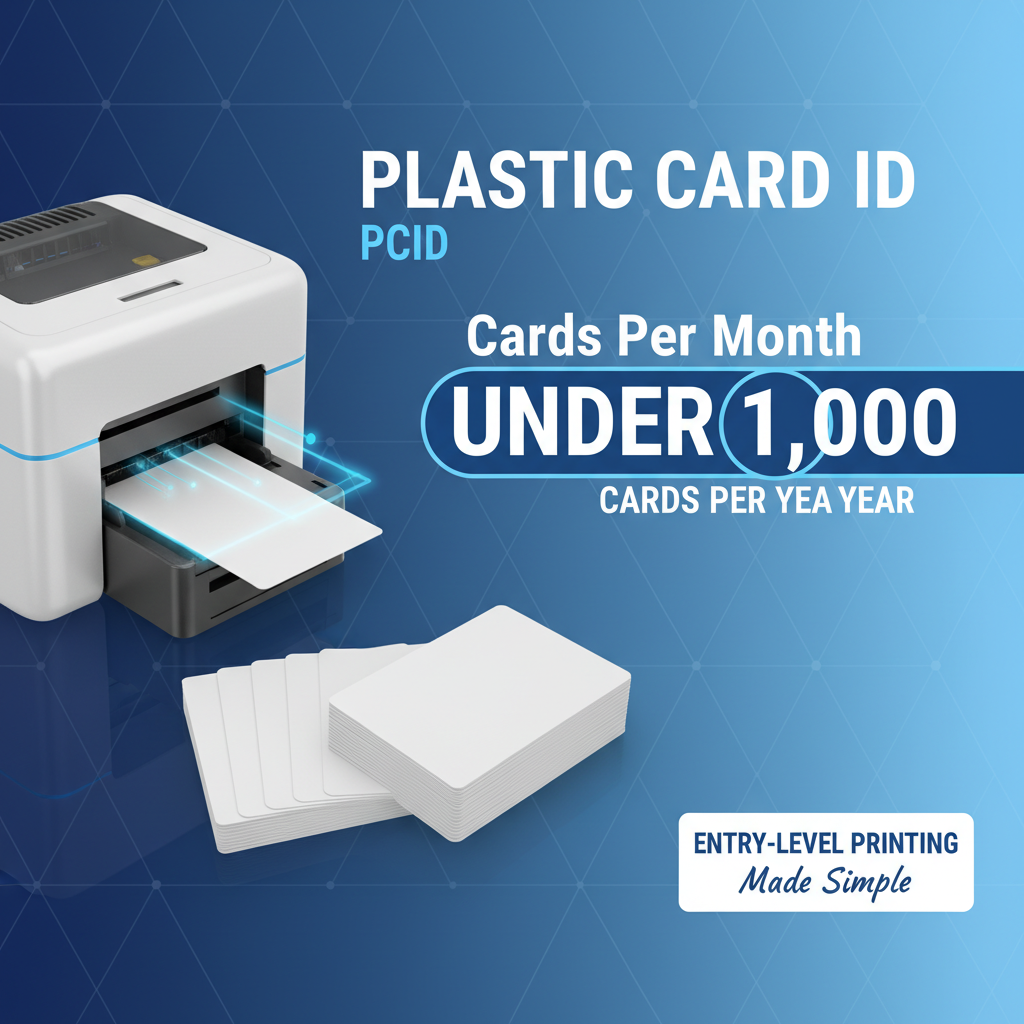 Not every organization needs a machine that can spit out thousands of cards a month. A small yoga studio issuing membership cards, a local volunteer organization producing staff badges, or a startup printing visitor passes - these use cases are entirely legitimate, and they deserve a printer that's appropriately sized, not overkill. Entry-level card printers deliver professional results without unnecessary complexity or cost.
The Evolis Badgy200 is purpose-built for this tier. Compact enough to sit on a corner of a desk, it prints full-color CR80 standard cards in a single pass and connects easily to most computers via USB. Its included Badgy software makes card design accessible even for users with no design background. For organizations printing fewer than 1,000 cards per year, this is the logical starting point.
Who Should Consider the Badgy200
Think small businesses issuing employee photo IDs, a community center producing member cards, a nonprofit printing volunteer credentials for seasonal events. The Badgy200 handles these tasks reliably and repeatedly without the footprint or cost of a commercial-grade unit. It's a capable, professional tool - just right-sized for real-world low-volume needs.
The total cost of ownership at this tier is notably low. Ribbons for the Badgy200 are affordable, and cleaning kits extend print head life significantly. For an organization printing a few dozen to a few hundred cards annually, annual supply costs are modest. This is one of the most cost-effective ways to bring card printing in-house.
Ribbon and Supply Considerations at Low Volume
At under 1,000 cards per year, full-color YMCKO ribbons are the standard choice, delivering vivid results on white PVC card stock. Monochrome ribbons in black or other single colors are available for applications where full color isn't required, lowering per-card cost further. CPE stocks both options and can help you calculate which ribbon format makes the most sense for your actual use case.
Storage matters more at low volume than many buyers realize. Ribbons left in a printer during long periods of inactivity can dry out or stick. Keeping spare ribbons in a cool, dry location and running a cleaning card through the unit every few hundred prints keeps image quality sharp. A simple maintenance routine doubles the usable life of your print head.
Contact Information for Entry-Level Buyers
If you're unsure whether the Badgy200 or another entry-level unit is right for your volume, the team at CPE can walk you through the options. Call 800.835.7919 for straightforward, no-pressure guidance from specialists who work with card printing programs of every size every day.
Don't let the "entry-level" label mislead you. Entry-level in card printing still means professional output - sharp color reproduction, clean edge definition, and cards that look exactly as polished as what a vendor would mail you. Bringing that production capability in-house is always about control and speed, not cutting corners.
Mid-Range Performance: 1,000 to 6,000 Cards Per Month
This is where most small-to-medium businesses live. A company issuing ID badges to a growing workforce, a university running a student card program, a regional hotel chain re-issuing key cards at scale - these are mid-range printing scenarios, and they demand something with more backbone than a desktop entry unit. The Evolis Zenius and Evolis Primacy2 are the workhorses of this category.
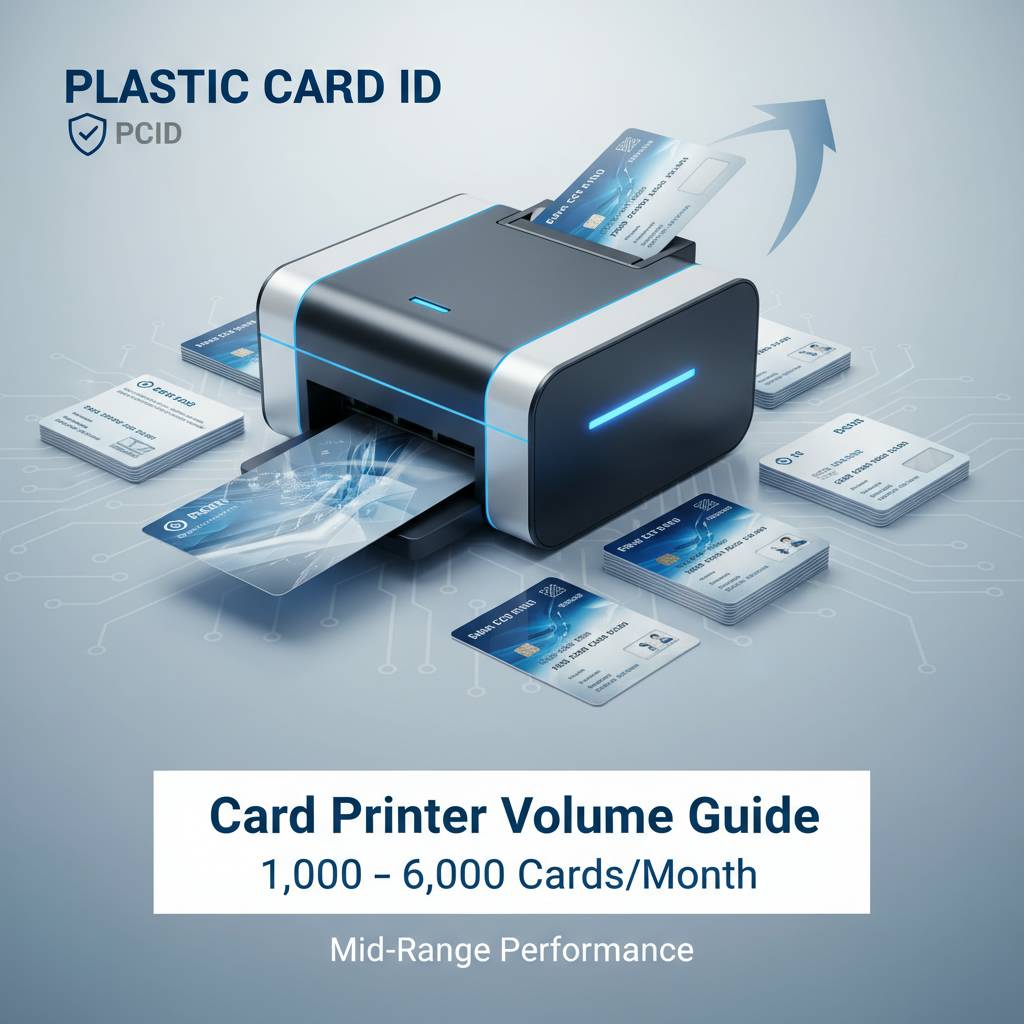
The Zenius is a single-sided printer with a clean, fast print mechanism and a larger ribbon capacity than the Badgy line. It's a step up in every measurable way: faster throughput, larger card input capacity, and optional connectivity upgrades. For programs in the 1,000-to-3,000-cards-per-month range, it's a natural fit. The Primacy2 extends the range upward, adding dual-sided printing capability and a broader palette of optional encoding modules.
Dual-Sided Printing: When You Need Both Faces
Single-sided printing covers a lot of ground, but dual-sided cards - those printed on both front and back - open up design and informational real estate that many programs quickly learn to appreciate. Employee ID cards with a photo and name on the front, policies or barcode on the back. Membership cards with benefits on the reverse. Dual-sided printing transforms a card from a simple identifier into a functional document.
The Evolis Primacy2 handles dual-sided printing natively, flipping the card automatically between passes. No manual intervention, no second print run. Combined with its speed and reliability at mid-range volumes, it makes a compelling case for any program where both sides of the card carry meaningful content. Setup is straightforward, and the Primacy2 integrates with most card design software without complexity.
Magnetic Stripe Encoding at Mid-Range Volumes
Access control, loyalty programs, timekeeping systems - many of these depend on magnetic stripe encoding embedded in the card itself. Mid-range printers like the Primacy2 support inline magnetic stripe encoding as an optional upgrade, meaning the card is printed and encoded in a single pass through the machine. Inline encoding eliminates a separate encoding step entirely, reducing labor and error rates in high-mix environments.
Magnetic stripe cards come in two grades: Lo-Co (low coercivity) and Hi-Co (high coercivity). Hi-Co stripes are more durable and resistant to erasure from proximity to other magnets - relevant for cards that get stored near smartphones or metal surfaces. CPE supplies both card types and can advise on which grade is appropriate for your specific application.
Fargo Printers for Security-Focused ID Programs
Fargo printers bring a different emphasis to the mid-range segment: security. Their HDP (High Definition Printing) technology prints onto a clear film that is then transferred to the card surface, producing sharp, tamper-evident output with no card surface texture to interrupt the image. For government ID programs, law enforcement credentials, or enterprise-grade access control, Fargo's retransfer printing process sets a higher security benchmark.
The Fargo HDP5000 is particularly well-regarded for high-quality, dual-sided retransfer printing at mid-to-high volumes. Cards produced on this system are difficult to reproduce fraudulently, and the retransfer process extends the life of the card surface in high-wear applications like tap-in access control at turnstiles. If your ID program carries a security mandate, Fargo deserves serious consideration.
Talk to an expert at Plastic Card ID about mid-range printer options - call 800.835.7919 today.
High-Volume Production: 2,000 to 6,000 Cards Per Month
 At this tier, the stakes change. A printer that stumbles costs real money - in downtime, in reprints, in program credibility. Universities issuing cards to a student body of tens of thousands, large hotel chains running key card issuance at front desk speed, enterprise companies managing access control for sprawling campuses - these programs need printers engineered for sustained, high-throughput production. Reliability and speed are the governing criteria here, not simplicity or compact footprint.
The Evolis Agilia represents the top of the Evolis lineup and delivers exactly what high-volume programs demand. Edge-to-edge full-color printing, rapid throughput, a robust card transport mechanism, and premium output quality combine in a unit designed to run hard without flinching. For organizations where image quality is non-negotiable - executive credentials, premium loyalty cards, high-visibility event badges - the Agilia raises the bar.
Evolis Agilia: Premium Output at Scale
What distinguishes the Agilia from lower-tier Evolis models isn't just speed - it's the consistency of output across long print runs. Color calibration stays tighter, print head alignment holds more precisely, and the overall card quality remains uniform whether you're printing card number 10 or card number 10,000. That consistency is what high-volume programs are actually paying for.
The Agilia also supports the full range of encoding options - magnetic stripe, smart chip contact, and contactless/RFID - making it appropriate for multi-function card programs where a single card type needs to serve multiple access or transaction systems simultaneously. For complex card programs, that inline versatility significantly reduces production complexity and error exposure.
Zebra ZC Series: Industrial Reliability
Zebra has long been a trusted name in enterprise identification, and the ZC Series brings that heritage to direct-to-card color printing with a focus on rugged reliability and software integration. Zebra printers connect smoothly into enterprise ID management ecosystems, supporting popular platforms with native driver support and a well-documented API for custom integrations. For IT-managed enterprise card programs, Zebra's ecosystem integration is a significant advantage.
The ZC Series covers a range of throughput requirements and includes dual-sided models suited to programs where both faces carry critical information. Card lamination options and encoding upgrades are available, and Zebra's print head longevity at high-volume duty cycles is a point of pride in the brand's documentation. Organizations that have standardized on Zebra for label printing often find natural synergy in extending that relationship to card printing.
Matica Event Printer: On-Site Speed Printing
Events present a unique challenge: hundreds or thousands of badge recipients arriving in waves, all expecting to be credentialed quickly. The Matica Event Printer is built specifically for this scenario - high-speed on-site badge printing that keeps registration lines moving and participants badged in seconds. When speed is the only metric that matters, the Matica Event Printer is in a class of its own.
Trade shows, conferences, corporate summits, sporting events - anywhere credentials need to be produced on-demand at pace, the Matica solution earns its place. It integrates with event registration systems and can be deployed with minimal setup time, which matters enormously when you're standing at a venue at 6 AM the morning of a conference. CPE can help configure the right supply kit to accompany the unit for any event scale.
Supplies That Keep Your Card Program Running
 A printer without the right supplies is hardware waiting to disappoint you. Ribbons, cleaning kits, and card stock are not afterthoughts - they're the ongoing cost of a card program, and choosing them correctly has a direct impact on output quality, per-card cost, and equipment longevity. Plastic Card ID stocks a full range of supplies for every printer in its lineup, from standard YMCKO color ribbons to specialty monochrome and overlay options.
Every ribbon format has a specific cost-per-card profile. Full-color YMCKO ribbons offer vibrant color output with an integrated overlay panel for card protection. Monochrome ribbons - available in black, blue, red, silver, and gold - drop the per-card cost substantially for applications that don't require color. Understanding which ribbon type your program actually needs is one of the simplest ways to optimize your ongoing supply budget.
Ribbon Types and When to Use Each
- YMCKO (Full Color Overlay): The standard choice for photo ID cards, loyalty cards, and any application requiring full-color personalization with a protective overlay panel.
- YMCKOK (Full Color Black Panel Overlay): Adds a dedicated black panel for sharper text and barcodes on the back of the card, ideal for dual-sided programs with text-heavy reverses.
- KO (Monochrome Overlay): Lower cost per card, suitable for single-color output on white card stock - often used for visitor passes or internal-use credentials.
- Monochrome Only (K): The lowest cost per card option, for simple, single-color card production where an overlay is not required.
- Specialty Ribbons (Silver, Gold, Red, Blue): For branded card programs where metallic or spot-color output adds visual value to the card design.
Cleaning Kits and Print Head Longevity
Print heads are the most expensive component in a card printer, and they are also the component most directly affected by inconsistent cleaning habits. Dust, card stock particulates, and ribbon residue all accumulate over time on the print head and transport rollers, degrading image quality and accelerating wear. A regular cleaning cycle - typically every 500 to 1,000 cards - is the single best maintenance habit you can build into your card program.
Cleaning kits include pre-saturated cleaning cards formatted to run through the printer's standard card path, cleaning swabs for manual head surface cleaning, and in some configurations, roller cleaning adhesive sheets. Running a cleaning cycle at ribbon changes is an easy habit to maintain and correlates directly with consistent output quality over the life of the printer. CPE supplies cleaning kits for all supported printer brands.
Lamination Modules and Card Durability
Lamination adds a thin protective film to the printed card surface, significantly extending the card's usable life in high-wear environments. Cards subjected to daily handling, exposure to moisture, or frequent swiping through readers benefit substantially from lamination. The Evolis Primacy2 and select other models support inline lamination modules that apply film in the same pass as printing. Laminated cards can last two to three times longer than unlaminated equivalents in demanding daily-use scenarios.
Lamination also provides a platform for security features. Holographic overlaminates introduce visual security elements that are difficult to replicate and easy for trained staff to verify at a glance. For ID programs with a security mandate, lamination upgrades represent a meaningful enhancement at modest additional per-card cost. Ask CPE about lamination module availability for your specific printer model.
| Supply Type | Typical Cost Range | Cards Per Ribbon / Kit | Best For |
|---|---|---|---|
| YMCKO Ribbon | $30-$90 | 100-300 cards | Full-color ID, membership, loyalty cards |
| Monochrome Ribbon (K) | $15-$45 | 500-1,000 cards | Visitor passes, internal credentials |
| Cleaning Kit | $10-$30 | Per 1,000 card maintenance cycle | All printers, all programs |
| Lamination Film | $40-$120 | 100-300 cards | High-wear, security ID programs |
Card Applications Across Industries
Card printing isn't a niche technology. It shows up across an enormous range of industries and use cases, and understanding how your specific application should inform your printer selection is genuinely useful. The card's purpose shapes every hardware and supply decision - from the print technology and encoding type to the lamination requirement and card stock grade.
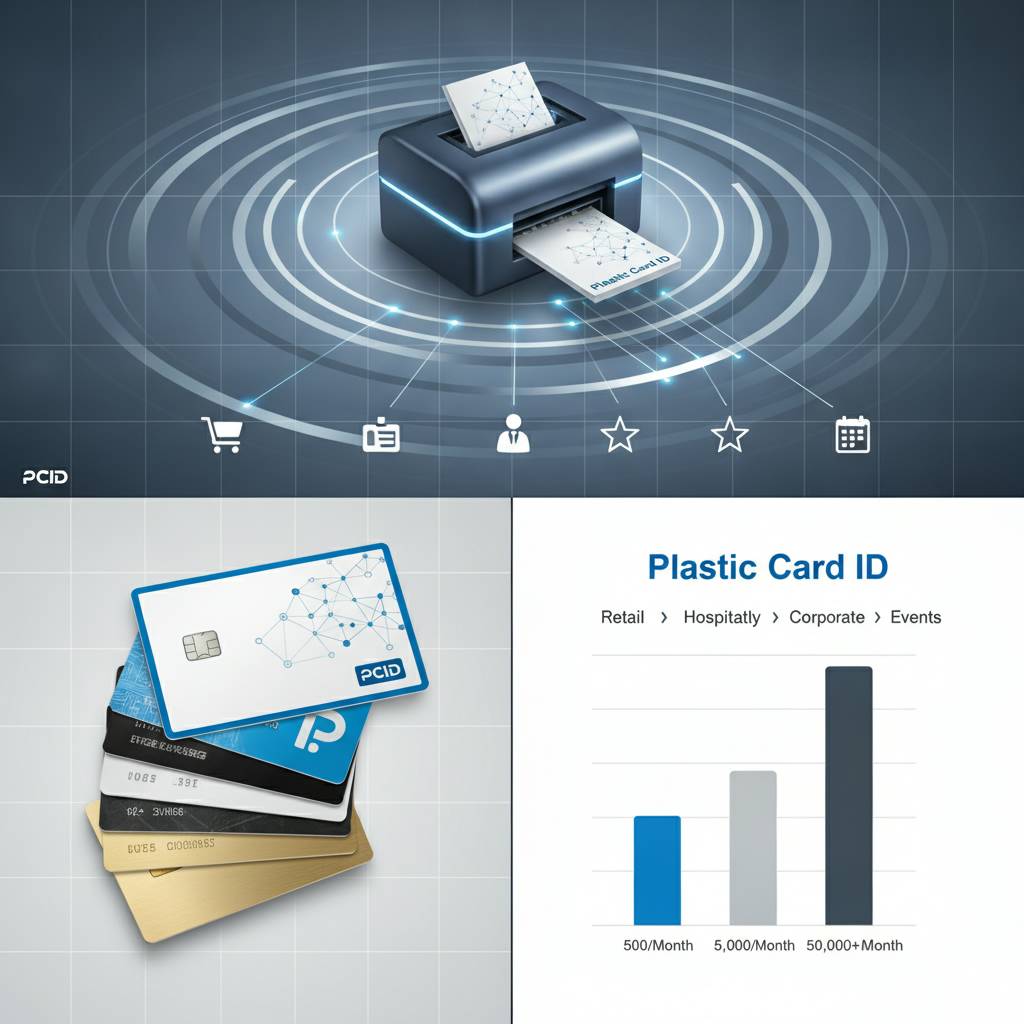
Employee ID cards, student IDs, hotel key cards, access control credentials, loyalty and membership cards, event badges - each has its own technical profile. A hotel key card must encode a contactless chip or magnetic stripe. A student ID in a high-traffic cafeteria environment benefits from lamination. An event badge needs speed above all else. Mapping your specific card type to the right hardware is exactly what the specialists at Plastic Card ID do every day.
Employee ID and Access Control Cards
Corporate and institutional ID programs almost always combine photo printing with some form of electronic credential - magnetic stripe for door access, proximity RFID for turnstile systems, or smart chip for multi-system authentication. The Evolis Primacy2, Fargo HDP5000, and Zebra ZC Series all support inline encoding for these use cases, producing a finished, encoded card in a single production pass.
The ability to print on demand is often what drives organizations to bring card production in-house in the first place. New hire starting Monday? Card ready in minutes, not days. Access profile changes? Re-encode and reissue the same day. In-house printing eliminates the vendor lead time entirely, giving HR and security teams the responsiveness that modern workplaces expect.
Membership and Loyalty Card Programs
Retail and hospitality businesses running loyalty programs have discovered that a professionally printed, personally branded card creates a tangible connection to the brand that digital-only alternatives struggle to match. There's something in the physicality of handing a customer their membership card that a push notification simply doesn't replicate. Producing those cards in-house keeps fulfillment fast and personalization genuinely personal.
Magnetic stripe encoding allows loyalty cards to carry member account data, enabling point-of-sale integration with most modern retail systems. Full-color YMCKO printing keeps the card visually sharp and brand-consistent. For mid-volume loyalty programs, the Zenius or Primacy2 is typically the right fit. High-volume national programs may warrant stepping up to the Agilia or a Zebra unit with a higher monthly duty cycle.
Event Credentials and Temporary Access Cards
Events are where the gap between inadequate and purpose-built hardware becomes painfully obvious. A printer that takes 45 seconds per card is fine for 50 attendees; it's a disaster for 2,000. The Matica Event Printer solves this at speed, handling credential issuance at a pace that keeps on-site registration flowing. For any event where credentials are issued on-site, production speed is the non-negotiable specification.
Hotel key cards represent another high-frequency, time-sensitive card application. Front desk staff can't wait minutes for a card to print and encode - the guest is standing right there. Encodable card printers paired with the right card stock and magnetic stripe media turn what could be a bottleneck into a seamless two-second operation. CPE supplies both the hardware and the encoded PVC card stock for these programs.
Buyer Tips: Choosing the Right Printer for Your Program
 After 25 years and more than 100,000 customers, certain patterns in buyer decisions emerge. Some mistakes are remarkably consistent - and avoidable. The buyers who get the most out of their card printer investment share a few habits in common. They think ahead, they size correctly, and they invest in supplies upfront rather than scrambling later.
Below are the practical guidelines that CPE's specialists share most often with new and upgrading buyers. These aren't sales points - they're genuine operational insights from watching card programs succeed and stumble across virtually every industry vertical imaginable.
Top Tips Before You Buy
- Count your cards honestly. Include peak months, not just your average. If you print 800 cards in September and 60 in February, size for September.
- Decide on encoding before you buy. Adding a magnetic stripe or smart chip module after the fact is possible on some models, but costs more and creates downtime. Know your encoding needs at purchase.
- Factor in dual-sided printing. Even if you don't currently use the back of the card, many programs expand to dual-sided within 12-18 months. The Primacy2's dual-sided capability is often worth the incremental cost upfront.
- Stock at least one spare ribbon. Running out mid-run - especially during an event or a new-hire orientation - is an avoidable disruption. Keep supplies on hand.
- Register your printer and set up a maintenance schedule. Warranty registration is simple and protects your investment. A cleaning schedule protects your print head.
- Ask about bundled starter kits. Plastic Card ID often offers printer-plus-supplies bundles that deliver better value than purchasing components separately.
Common Mistakes to Avoid
Underbuying is the most common error - purchasing an entry-level unit because the price is right, only to find it can't keep up with actual demand within six months. The flip side is also real: over-specifying for a program that genuinely only needs 200 cards a year ties up capital in hardware that sits mostly idle. Right-sizing is the goal, and it's achievable with honest volume assessment.
Another frequent misstep is overlooking total cost of ownership. A printer priced at $400 with expensive proprietary ribbons may cost more per card over two years than a $600 unit with better ribbon yield. Always calculate cost per card - ribbon price divided by ribbon yield in cards - before comparing printer prices in isolation. CPE can help run those numbers for any model in the lineup. Call 800.835.7919 for a quick supply cost breakdown tailored to your estimated volume.
How to Estimate Your Total Annual Supply Budget
Take your estimated monthly card volume, multiply by 12 for annual volume, and divide by the yield per ribbon in your selected format. That gives you annual ribbon count. Multiply by ribbon price. Add one cleaning kit per 1,000 cards printed (approximately), and factor in one set of lamination film if you're using a laminator. A realistic supply budget is critical to building a card program that doesn't run out of fuel at an inconvenient moment.
Most mid-range programs running 1,000-3,000 cards per month find their annual supply budget falls in the $600-$2,500 range depending on ribbon format and lamination choice. High-volume programs will see that scale proportionally. The investment is predictable and controllable, which is one of the genuine advantages of in-house card production over outsourcing to external vendors.
Why Plastic Card ID Is the Partner Your Card Program Needs
 Over two and a half decades, Plastic Card ID has built something that outlasts any individual product cycle: genuine expertise in card printing programs across every industry, every scale, and every use case. That depth of experience is what separates a transactional supplier from a real partner. When you call with a question about encoding compatibility or ribbon yield, you get an answer from someone who has solved that problem before - many times.
The lineup of Evolis, Fargo, Zebra, and Matica printers represents the best available options across every volume tier. Each brand earns its place in the catalog on the merits of its hardware, its support ecosystem, and its track record in real-world card programs. Pair that with a full supplies catalog - ribbons, cleaning kits, lamination modules, encoding upgrades, card stock, sleeves and carriers - and Plastic Card ID delivers everything a card program needs under one roof.
In-House Printing Versus Outsourcing
The math on in-house printing gets compelling fast. Outsourcing card production to a vendor means lead times of days to weeks, minimum order quantities, per-card costs that include vendor margin, and zero ability to personalize or encode on the fly. Bringing production in-house flips every one of those disadvantages. Print one card or a thousand. Encode each card with unique data. Issue credentials the moment they're needed.
The upfront investment in a quality card printer typically pays back within one to two years for most mid-volume programs when measured against outsourcing costs. For programs with frequent personalization needs or time-sensitive issuance requirements, the payback can be far faster. The operational control that in-house printing provides - the ability to change a card, reprint a damaged one, encode a new access profile - is genuinely difficult to put a price on.
The Full Product Ecosystem
Beyond the printers themselves, a complete card program requires card stock, ribbons, cleaning supplies, and often accessories like card carriers, badge reels, and protective sleeves. Plastic Card ID supplies all of it. Buying from a single supplier who understands how each component interacts with the others means fewer compatibility questions, simpler reordering, and the confidence that your supplies are matched to your specific hardware. One call, one supplier, one card program running smoothly.
Whether you're starting a card program from scratch, upgrading from aging equipment, or scaling an existing program to meet growing demand, Plastic Card ID has the products and the expertise to get you there efficiently. The team knows the hardware deeply, understands supply economics, and has the patience to walk any buyer through the decision - no matter how many questions it takes.
Ready to Get Started
The right card printer is out there for your program - sized for your volume, equipped for your encoding needs, and supported by a supply chain you can count on. The fastest way to narrow it down is a five-minute conversation with someone who knows this space inside and out.
Contact Plastic Card ID today and let the experts match you to the right printer for your card program volume. Call 800.835.7919 now - professional guidance, no pressure, just answers.
Previous Page