Plastic Card Printer for Employee ID Cards: Top Picks
Table of Contents []
- Why Plastic Card ID Is the Go-To Source for Plastic Card Printers for Employee ID Cards
- Choosing the Right Plastic Card Printer for Employee ID Cards: A Volume-Based Framework
- Printer Features That Actually Matter for Employee ID Card Programs
- Fargo and Zebra Printers: Security-First ID Solutions
- What a Complete Employee ID Card Program Looks Like
- Frequently Asked Questions About Plastic Card Printers for Employee IDs
- Ready to Build Your Employee ID Card Program? Contact Plastic Card ID Today
Why Plastic Card ID Is the Go-To Source for Plastic Card Printers for Employee ID Cards
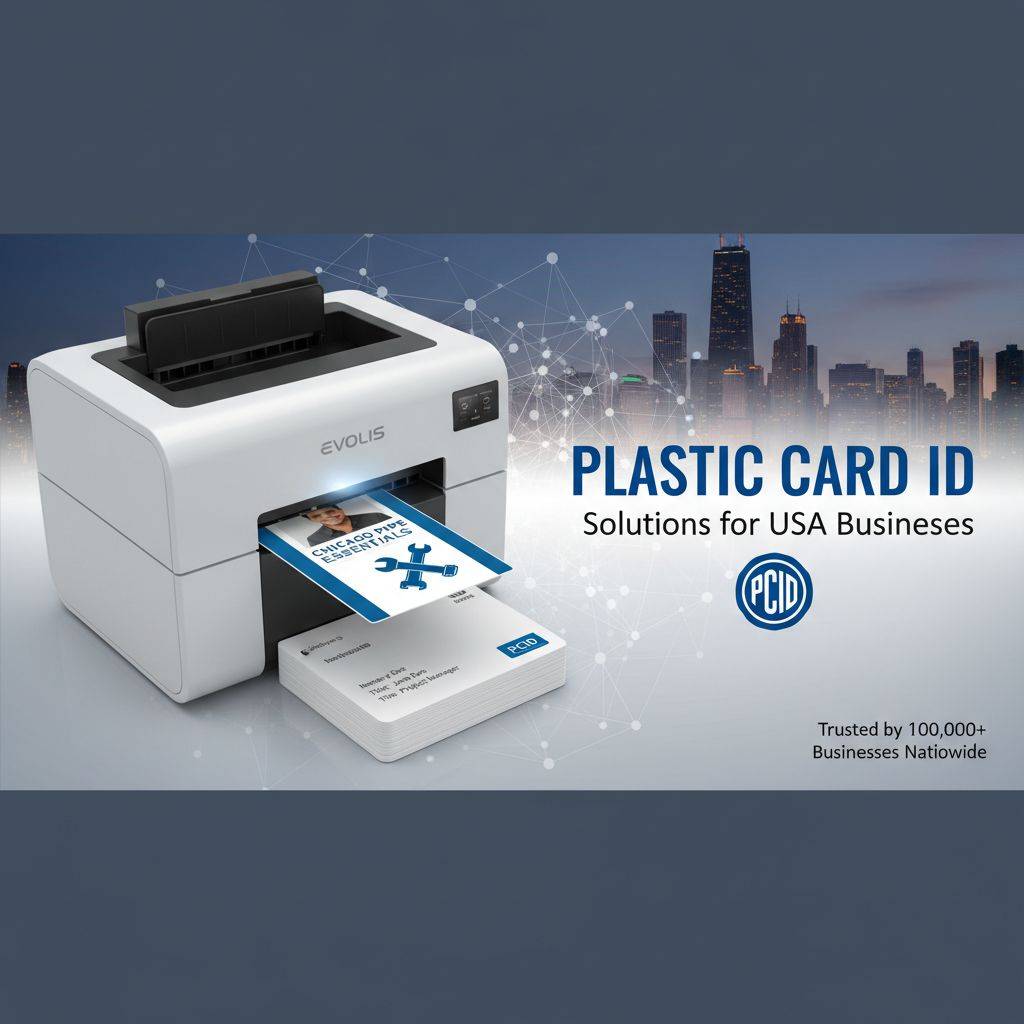 There's a moment every growing organization hits - the realization that handing out generic, flimsy ID badges simply isn't cutting it anymore. Security tightens, brand standards rise, and suddenly the question becomes: how do we take control of our own card printing program? That's exactly the kind of challenge Plastic Card ID has been solving for businesses across the United States for over 25 years, serving more than 100,000 customers along the way.
Whether you're running a 50-person company or managing credentials for thousands of employees across multiple facilities, the right plastic card printer for employee ID cards changes everything. You print when you need to, personalize every card, encode magnetic stripes or smart chips, and never wait on an outside vendor again. CPE carries the full range of hardware, supplies, and accessories to make that happen - right out of the box.
This page breaks down everything you need to know: which printers fit which programs, what features actually matter, how to match your print volume to the right machine, and why buying from a specialized supplier with a quarter-century track record beats the alternatives every time.
The Real Cost of Outsourcing Your Employee ID Cards
Outsourcing card production to a third-party print vendor feels convenient - until it isn't. Lead times stretch from days to weeks. A new hire starts Monday and their badge arrives Thursday. An employee loses their card and you're placing another minimum-order just to replace one. The costs add up quietly: per-card fees, rush charges, shipping, and the simple loss of control over your own security program.
In-house card printing eliminates that dependency entirely. With your own plastic card printer for employee ID cards, you produce cards on demand, in minutes, with your exact branding, encoding, and security features. The upfront investment pays for itself faster than most organizations expect, especially once they calculate what they were previously spending per card through outside vendors.
Who Needs a Dedicated Card Printer?
The short answer: almost any organization that issues ID cards regularly. Schools printing student and staff IDs, healthcare facilities managing access credentials, corporate campuses controlling building entry, manufacturers issuing safety-required identification - all of these are natural fits for an in-house card printer setup.
Loyalty programs, membership organizations, hotel chains managing key cards, and event venues issuing credentials also benefit enormously. If your organization prints more than a few hundred cards per year, the math almost always favors owning your own printer. CPE can help you run those numbers before you commit to anything.
What Sets Plastic Card ID Apart
Plenty of resellers carry a printer or two. Plastic Card ID carries a curated, professional-grade lineup from the industry's most trusted brands - Evolis, Fargo, Zebra, and Matica - and backs every sale with the kind of expertise that comes from 25 years of doing exactly this. No guesswork, no mismatched hardware, no "good luck with setup."
The difference is specialization. When you call CPE, you're talking to people who understand card printers the way a mechanic understands engines - not just the sales specs, but the real-world performance, the consumables that matter, the encoding options that actually work for your specific use case. That depth of knowledge is something a general-purpose electronics retailer simply cannot offer.
| Printer Model | Brand | Volume Range | Best For | Key Features |
|---|---|---|---|---|
| Badgy200 | Evolis | Under 1,000/year | Small offices, startups | Compact, affordable, full color |
| Zenius | Evolis | 1,000-3,000/month | Mid-size businesses | Single-sided, encoding ready |
| Primacy2 | Evolis | Up to 6,000/month | Corporate, healthcare, education | Dual-sided, mag stripe, chip encoding |
| Agilia | Evolis | High volume | Premium output requirements | Edge-to-edge, highest quality |
| HID Fargo Series | Fargo | Varies by model | Security-focused ID programs | Advanced encoding, lamination |
| Zebra ZC Series | Zebra | Varies by model | Enterprise ID programs | Robust build, enterprise integration |
| Event Printer | Matica | High-speed on-site | Events, conferences, venues | Fast throughput, on-demand |
Choosing the Right Plastic Card Printer for Employee ID Cards: A Volume-Based Framework
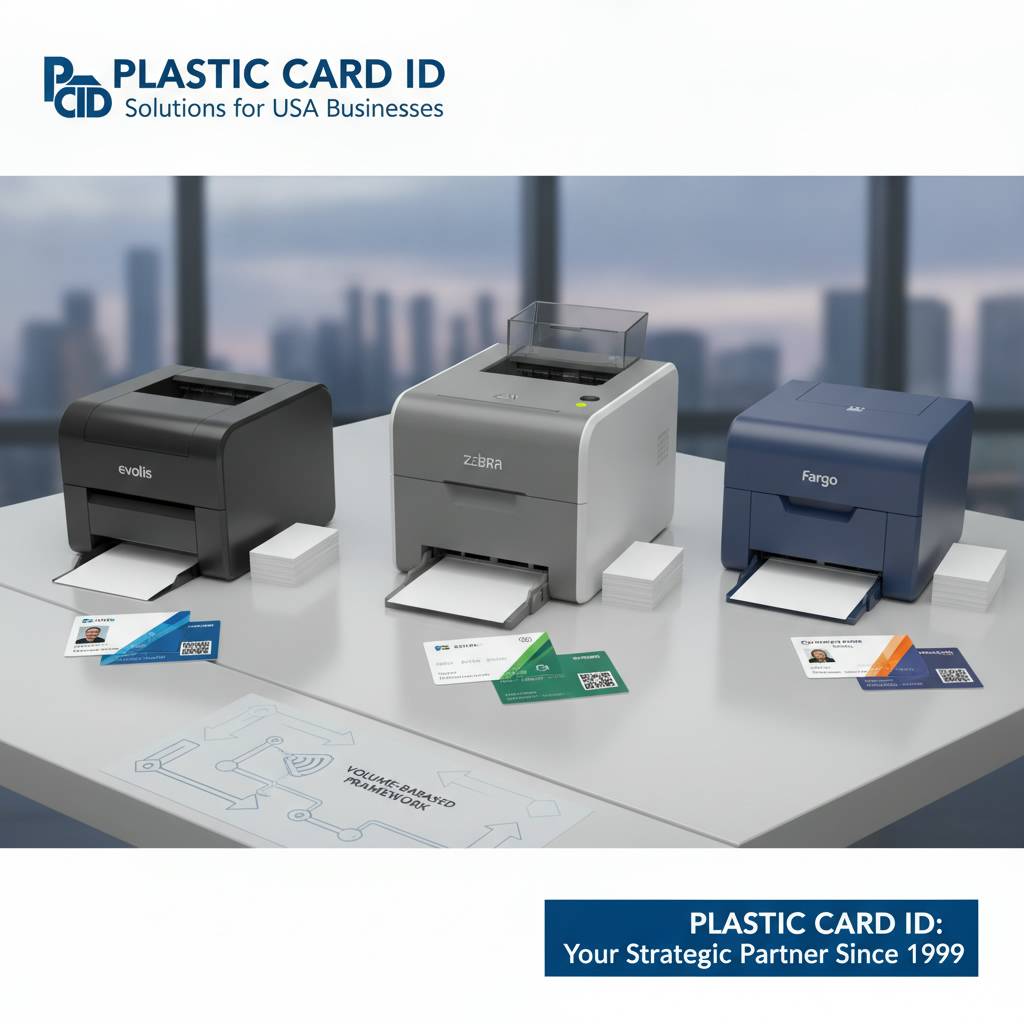 Volume is the single most important variable when selecting a card printer. Buy too little machine and you'll be waiting on print jobs and burning through consumables inefficiently. Buy too much and you're overpaying for capacity you'll never use. Matching printer to print volume is the foundation of a smart buying decision, and it's where CPE guides every customer before anything else.
The good news: the lineup covers every realistic scenario. Small nonprofits, mid-size regional employers, large hospital systems, university campuses - there's a right-sized solution for each. What follows is a practical breakdown of the categories, so you can narrow your options before you even pick up the phone.
Entry-Level Printers: Under 1,000 Cards Per Year
The Evolis Badgy200 is the entry point for organizations with modest but real printing needs. Small offices, boutique retailers issuing loyalty cards, community organizations printing member IDs - these environments don't need industrial throughput. They need a reliable, easy-to-operate desktop unit that produces professional-looking cards without a learning curve.
The Badgy200 prints full-color cards at a size and quality that puts anything produced by an outside vendor to shame. Setup is straightforward, the software is approachable, and the per-card cost with YMCKO ribbon is predictable and manageable. For an organization printing a few hundred cards per year, this is often all the printer they'll ever need.
Mid-Range Workhorses: 1,000 to 6,000 Cards Per Month
This is where most businesses find their home. The Evolis Zenius and Primacy2 occupy the productive middle ground - capable enough for serious volume, refined enough to produce cards that represent your brand with confidence. The Primacy2 in particular is a dual-sided powerhouse, printing front and back in a single pass and supporting magnetic stripe and smart chip encoding right out of the box or via upgrade.
Mid-size companies, regional healthcare networks, school districts, and corporate campuses tend to land in this tier. Monthly volumes in the 1,000-6,000 range are handled smoothly, ribbon consumption stays predictable, and the machines are built to run day after day without complaint. If your employee headcount is growing, starting here gives you room to scale.
High-Volume and Premium Output: Evolis Agilia and Beyond
Some organizations can't compromise on output quality. Government agencies, financial institutions, universities with branded ID programs, large healthcare systems - these environments demand edge-to-edge printing, pixel-perfect color accuracy, and throughput that keeps up with demand without bottlenecking operations. The Evolis Agilia was built for exactly that standard.
Beyond the Agilia, Fargo and Zebra round out the high-performance tier with enterprise-class machines designed for security-intensive ID programs. Lamination modules, holographic overlays, and multi-technology encoding options make these printers the right choice when the card itself is a security document, not just an identifier. CPE can walk you through which configuration fits your specific program requirements.
Event and On-Site Badge Printing: The Matica Advantage
Not every card printing need fits neatly into a recurring monthly cadence. Conferences, trade shows, large corporate events, university orientation days - these situations demand high-speed on-site badge production that keeps pace with crowds. The Matica Event Printer was engineered for exactly this scenario.
Fast throughput, reliable operation under pressure, and the ability to print personalized credentials on demand makes the Matica a purpose-built solution rather than a compromise. Organizations that host regular events and need a dedicated on-site printing capability will find it performs where general-purpose printers struggle. Call 800.835.7919 to discuss event printing configurations in detail.
Printer Features That Actually Matter for Employee ID Card Programs
Spec sheets can overwhelm. DPI ratings, ribbon panel configurations, encoding options, connectivity specs - it's easy to lose the thread of what actually matters for your program. The features that drive real value are the ones that match your specific cards, your workflow, and your security requirements, not the ones with the highest numbers on paper.
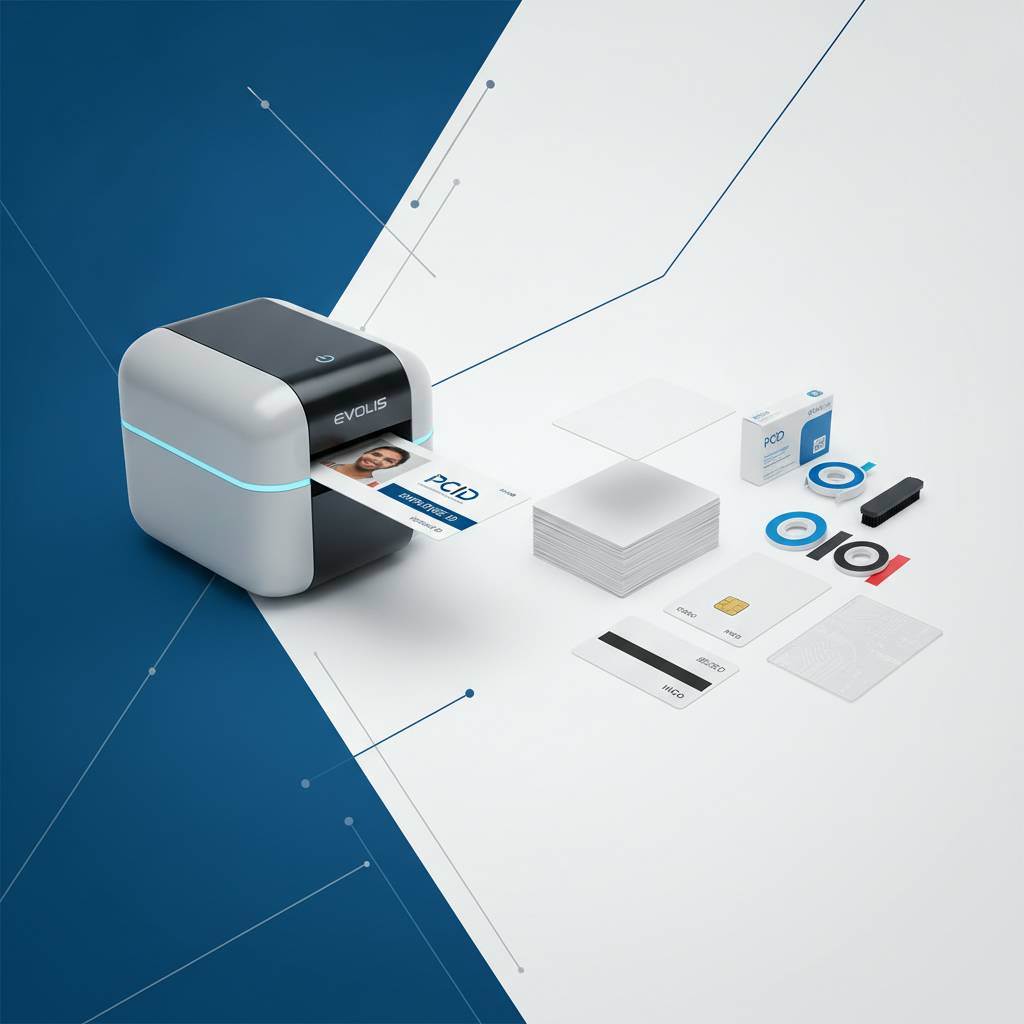
Here's a clear-eyed look at which features deserve your attention and why, so you can evaluate any printer in the lineup with confidence rather than confusion.
Single-Sided vs. Dual-Sided Printing
Single-sided printers are simpler, faster per card, and less expensive - both upfront and in consumables. They're the right call when your employee ID card design lives entirely on one face, which is more common than you might think. Logo, photo, name, title, department - that's a lot of information and it often fits cleanly on one side.
Dual-sided printing opens up real estate for additional information: barcode, emergency contact, policy acknowledgment, secondary encoding, department color coding. If your card design requires both sides, the Primacy2 and select Fargo and Zebra models handle this natively, printing both faces in a single pass rather than requiring you to flip and reload. Dual-sided capability is a genuine workflow upgrade for programs that use it, and an unnecessary cost for those that don't.
Encoding Options: Magnetic Stripe, Smart Chip, and More
A plastic card printer for employee ID cards that only prints is only doing half the job for many organizations. Magnetic stripe encoding lets cards double as access control credentials, time-clock inputs, or cafeteria payment tokens. Smart chip encoding - both contact and contactless - opens doors to more sophisticated access control systems and secure data storage applications.
Most printers in CPE's lineup support encoding either as a standard feature or as an upgrade module. This is important: buying a printer today that can accommodate encoding tomorrow means you're not locked into a hardware replacement cycle if your program evolves. Future-proofing your printer selection with encoding flexibility is smart buying.
Ribbons, Cleaning Kits, and Ongoing Consumables
A printer is only as good as the consumables running through it. YMCKO ribbons (yellow, magenta, cyan, black, overlay) produce full-color output with a protective topcoat. Monochrome ribbons handle high-volume single-color prints at a much lower per-card cost - useful when you're printing basic text-only cards in volume. Specialty ribbons for specific applications round out the options.
- YMCKO Ribbons: Full-color output with protective overlay; ideal for photo ID cards
- Monochrome Ribbons: Single color, high-yield; best for high-volume text-only or barcode cards
- Cleaning Kits: Essential for print head longevity and consistent output quality
- Lamination Modules: Add a durable protective layer; increases card lifespan significantly
- Input Hoppers: Expand card loading capacity for higher-volume print runs
- Card Carriers and Sleeves: Protect finished cards during handling and distribution
Plastic Card ID supplies all of these. Ordering consumables through the same source as your printer hardware means compatibility is guaranteed, and you're not playing guessing games with third-party ribbon brands that may or may not perform to spec.
Fargo and Zebra Printers: Security-First ID Solutions
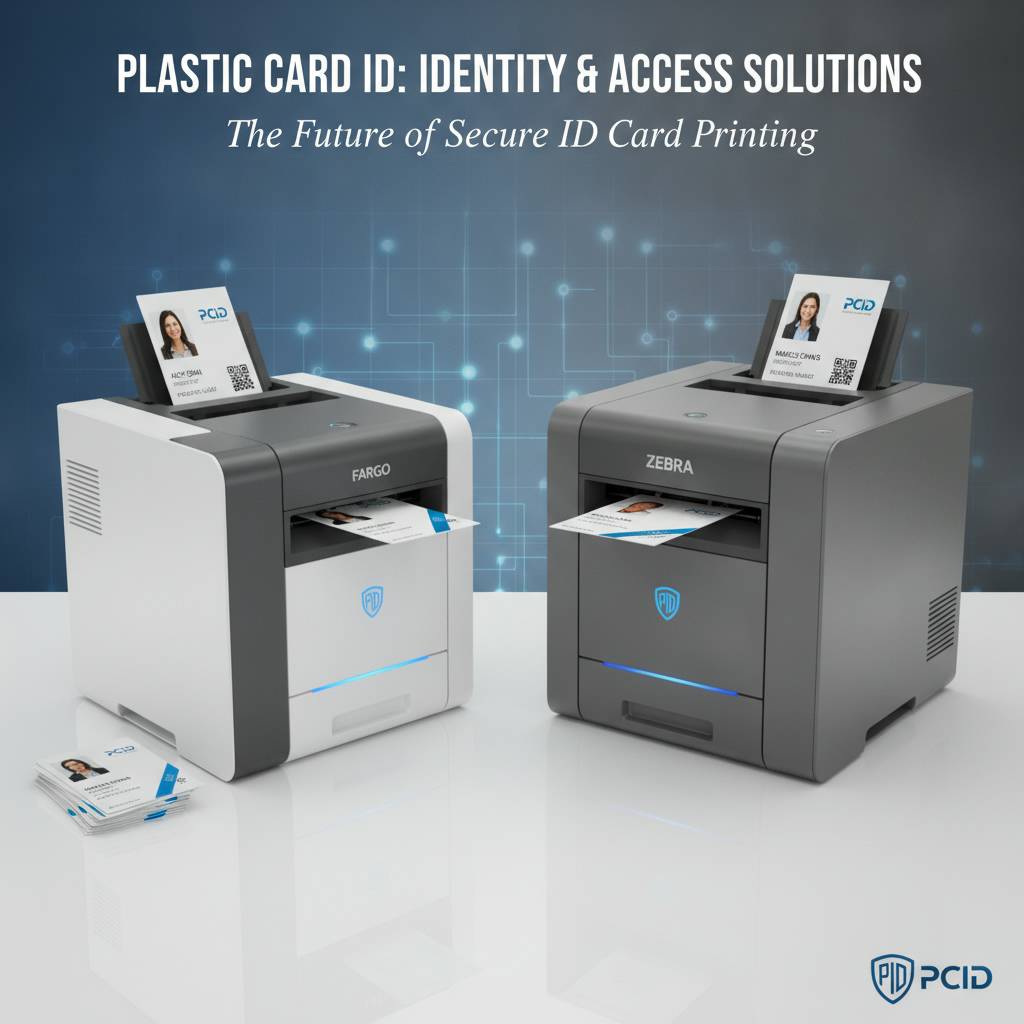 When the ID card itself carries security weight - when it's not just identifying someone but actively controlling what they can access - the printer choice takes on a different dimension. Fargo and Zebra have built their card printer reputations on exactly this kind of security-critical application. Law enforcement agencies, government contractors, financial institutions, and large corporate security programs all gravitate toward these platforms for good reason.
Robust construction, advanced encoding support, lamination capabilities, and enterprise-grade software integration set Fargo and Zebra apart in security-focused deployments. CPE carries both brands and can match specific models to the security infrastructure you're already running.
Fargo Printers: Precision for High-Stakes ID Programs
Fargo's lineup - distributed under the HID brand family - has long been the choice of organizations where card security isn't optional. The printers support a wide range of encoding technologies, including proximity, smart card, and magnetic stripe, and the lamination options available add tamper-evident, holographic overlays that significantly increase card security.
For organizations running formal visitor management programs, contractor credentialing, or government-issued identification, Fargo's capabilities extend well beyond what a general-purpose printer offers. The hardware is built to handle these demands consistently, shift after shift. Reach the team at 800.835.7919 to discuss which Fargo configuration aligns with your security requirements.
Zebra Printers: Enterprise Integration at Scale
Zebra's card printer lineup brings enterprise-level reliability to large-scale ID programs. Their ZC Series printers integrate smoothly with existing enterprise software environments, support multiple encoding technologies, and are engineered for the kind of consistent, high-volume output that large organizations demand. When your ID program is enterprise infrastructure rather than a department tool, Zebra is built for that scale.
The build quality on Zebra hardware is designed for longevity in demanding environments. These aren't printers you replace annually - they're investments in a card production capability that runs reliably for years. Combined with CPE's supply chain for ribbons and accessories, a Zebra-based card program is a genuinely long-term solution.
Choosing Between Fargo and Zebra
Both brands excel, but they serve slightly different strengths. Fargo tends to be the preference where security overlays, holographic lamination, and advanced anti-counterfeiting features are paramount. Zebra typically wins in environments where enterprise IT integration, software compatibility, and high-volume throughput are the primary drivers.
The honest answer is that the right choice depends on your specific program, your existing infrastructure, and your encoding requirements. Plastic Card ID has the experience to guide that decision without steering you toward a higher price point than your program actually needs. That kind of honest recommendation is rare, and it's part of what keeps customers coming back.
What a Complete Employee ID Card Program Looks Like
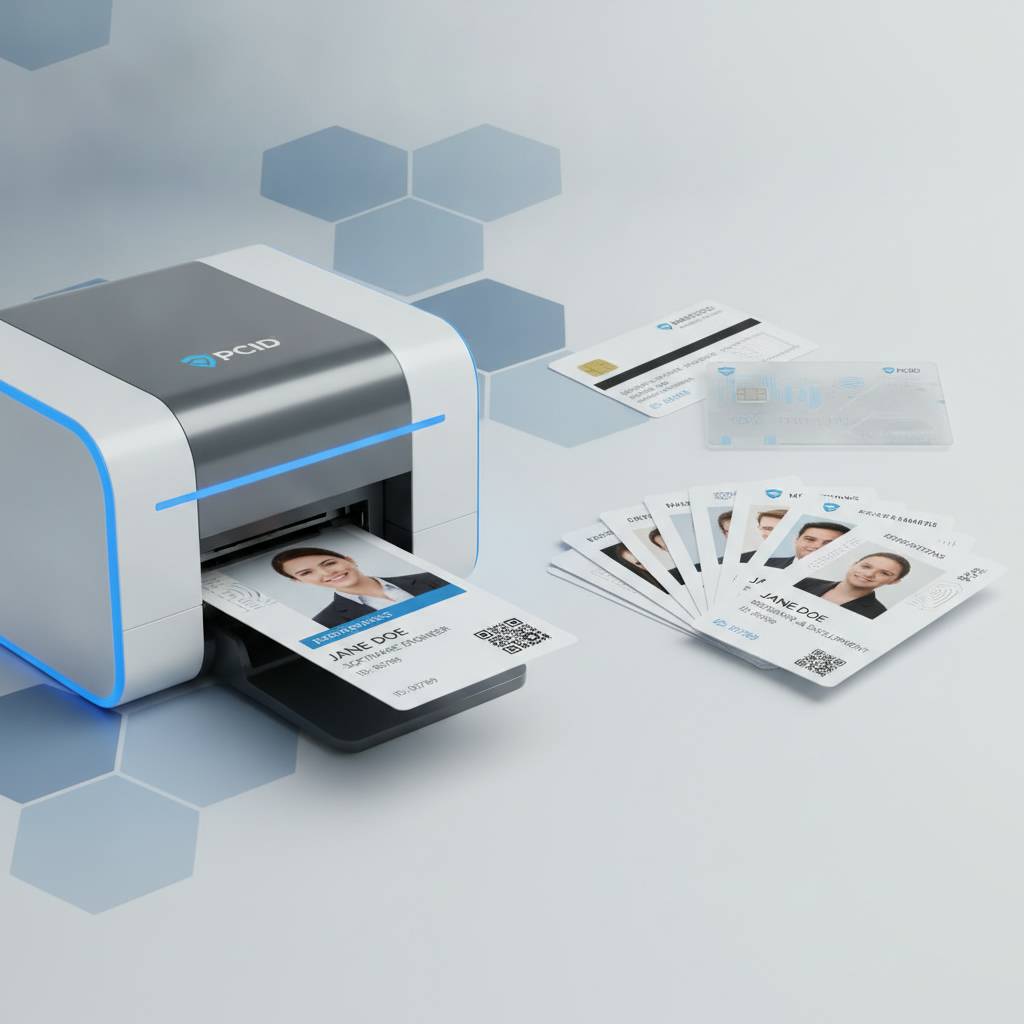 A printer alone doesn't run a card program. The most efficient, professional ID programs are built around a complete ecosystem - hardware, consumables, accessories, and the workflow knowledge to tie it all together. Plastic Card ID supplies every component of that ecosystem, which means you're not patching together parts from five different vendors.
Here's what a complete setup typically includes, from the first card printed to the thousandth.
Hardware: The Printer and Its Accessories
The printer is the center of the program, but accessories extend its capability significantly. Input hoppers allow larger batch print runs without manual card feeding. Lamination modules - available as integrated options on select printers - apply a durable protective film that extends card life and adds a security layer. Encoding upgrades for magnetic stripe or smart chip can often be added to base printer models, giving you flexibility to grow.
Selecting the right accessories at purchase is smarter than retrofitting later. CPE walks customers through a complete needs assessment so the initial order covers everything the program requires rather than discovering gaps after setup. Getting the full picture upfront saves both time and money.
Consumables: Keeping the Program Running
Ribbons, cleaning kits, and blank PVC cards are the ongoing fuel for any card printing operation. Running out of ribbon mid-batch, neglecting cleaning cycles, or using incompatible cards with your printer are the most common causes of poor output quality and premature print head failure. These are avoidable problems when you're sourcing consumables from a supplier who knows the hardware.
- Order ribbons in quantities that match your print volume to minimize waste and storage burden
- Follow manufacturer-recommended cleaning cycles - typically every ribbon change
- Use cards that meet the printer's thickness and surface specifications
- Stock cleaning kits as part of your standard supply order, not as an afterthought
Plastic Card ID carries the full consumables lineup for every printer brand in their portfolio. Reordering is straightforward, compatibility is guaranteed, and you're never left hunting for a ribbon that fits your specific machine.
Card Design and Personalization Considerations
The best printer in the world produces mediocre cards if the design isn't set up correctly. Card design for ID programs involves more than placing a logo and a name - it's about information hierarchy, photo placement, barcode positioning, encoding field layout, and color management for accurate reproduction. A well-designed card communicates professionalism and authority at a glance.
Most printers in CPE's lineup come with bundled card design software that handles the basics effectively. For organizations with more complex design requirements or existing brand standards, higher-tier software options integrate cleanly with the hardware. The goal is a card that looks as good as the organization it represents - and the right printer setup makes that achievable without a graphic design degree.
Frequently Asked Questions About Plastic Card Printers for Employee IDs
After 25 years and more than 100,000 customers, Plastic Card ID has heard every question there is about card printers. The ones below come up most often from organizations evaluating their first in-house card printing setup - or upgrading from a printer that's no longer keeping pace with their program.
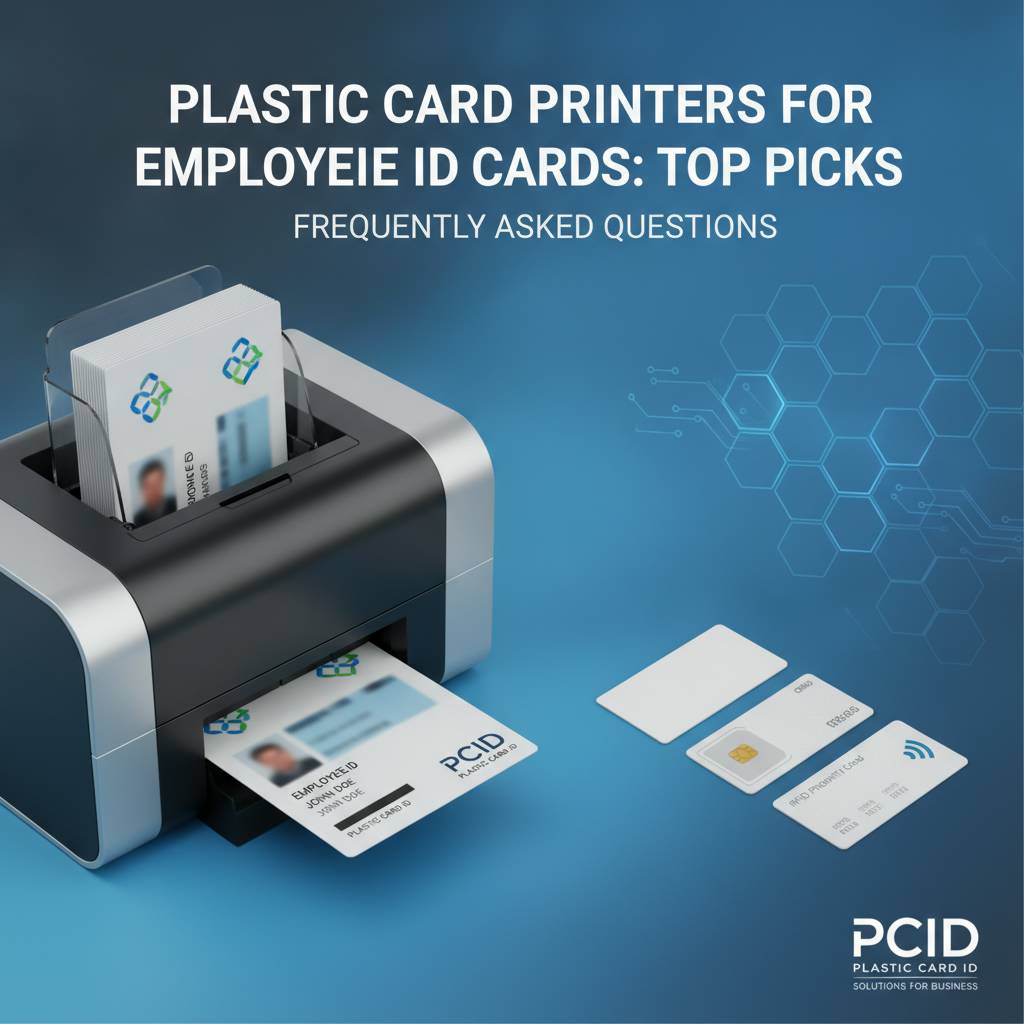
How Many Cards Per Year Do I Need to Print to Justify Buying a Printer?
There's no universal threshold, but most organizations find the break-even point somewhere between 300 and 500 cards per year when comparing in-house printing costs to vendor pricing. Below that number, the calculus can favor outsourcing - but speed of production and on-demand capability often tip the decision toward ownership even at lower volumes.
Organizations that issue cards irregularly - replacing lost cards, onboarding new staff in small batches - benefit from ownership even more than the annual volume suggests, because the alternative is paying rush fees or minimum order charges to an outside vendor every time an urgent need arises. Control over your timeline is worth real money.
What's the Difference Between a $500 and a $2,000 Card Printer?
Price reflects volume capacity, print speed, encoding options, construction quality, and feature set. An entry-level printer like the Badgy200 is priced for occasional use - it does the job beautifully within its design parameters, but it's not built to print 500 cards a day, every day. A mid-range or high-volume printer is engineered for sustained output, faster throughput, and often includes or supports encoding that lower-tier models don't.
Overspending on capability you'll never use is as poor a decision as underspending on a printer that can't keep up. CPE helps customers identify the right price-to-capability match for their actual program, not the highest-margin option. Expect typical ranges across the lineup to run from roughly $400-$600 for entry-level up to $2,000-$5,000 or more for high-volume and security-grade configurations.
Can I Add Encoding to a Printer I Already Own?
It depends on the model. Many printers in CPE's lineup are designed with modular encoding upgrades in mind - magnetic stripe and smart chip encoding modules can be added after purchase on select Evolis, Fargo, and Zebra models. Others require encoding to be specified at time of purchase.
This is an important question to ask before buying. If there's any chance your program will need magnetic stripe encoding for access control or time-clock applications, it's worth either buying the encoding-ready model upfront or confirming that the upgrade path exists. Planning for future capability today is almost always less expensive than replacing hardware tomorrow.
Ready to Build Your Employee ID Card Program? Contact Plastic Card ID Today
 After 25 years and over 100,000 customers served, Plastic Card ID brings a depth of expertise to plastic card printers for employee ID cards that simply isn't found at general-purpose retailers. The lineup is curated, the guidance is genuine, and the supply chain for ribbons, cleaning kits, and accessories means your program stays running long after the initial purchase.
From a small office printing a few hundred employee IDs per year to a large enterprise managing thousands of access credentials monthly, the right printer configuration exists in CPE's portfolio. The goal is always the same: match you to the exact solution your program needs, at the volume you actually print, with the features that genuinely serve your operation.
Talk to an Expert Before You Buy
Card printer buying decisions involve enough variables that a five-minute conversation with an experienced advisor saves time, money, and frustration. Which brand fits your security requirements? Which model handles your volume without overkill? Do you need encoding now, or is a future-ready configuration the smarter call? These are exactly the questions CPE answers every day.
The team is ready to walk through your specific situation, compare options honestly, and get you pointed toward the right solution - without pressure toward a higher price point than your program warrants. That's the kind of straightforward expertise that keeps customers coming back after 25 years.
Your Complete Card Program, All in One Place
Beyond the printer itself, Plastic Card ID supplies every consumable and accessory your card program requires: YMCKO and monochrome ribbons, cleaning kits, lamination modules, encoding upgrades, input hoppers, and card carriers and sleeves. One supplier, complete program, guaranteed compatibility - that's the CPE advantage.
Stop waiting on outside vendors, paying rush fees, or settling for cards that don't represent your organization the way they should. Plastic Card ID has the printers, the supplies, and the expertise to put a professional employee ID card program in your hands - on your timeline, at your volume, with your brand.
Call 800.835.7919 today to speak with a card printing specialist and get your program started the right way.
Previous Page