Dual-Sided Plastic Card Printer: Print Both Sides Efficiently
Table of Contents []
- Why Plastic Card ID Is the Go-To Source for Dual-Sided Plastic Card Printers
- Choosing the Right Dual-Sided Plastic Card Printer for Your Volume
- The Business Case for In-House Dual-Sided Card Printing
- Ribbons, Supplies, and Accessories That Keep Your Program Running
- Frequently Asked Questions About Dual-Sided Plastic Card Printers
- Card Programs That Benefit Most From Dual-Sided Printing
- Work With Plastic Card ID to Build Your Dual-Sided Card Printing Program
Why Plastic Card ID Is the Go-To Source for Dual-Sided Plastic Card Printers
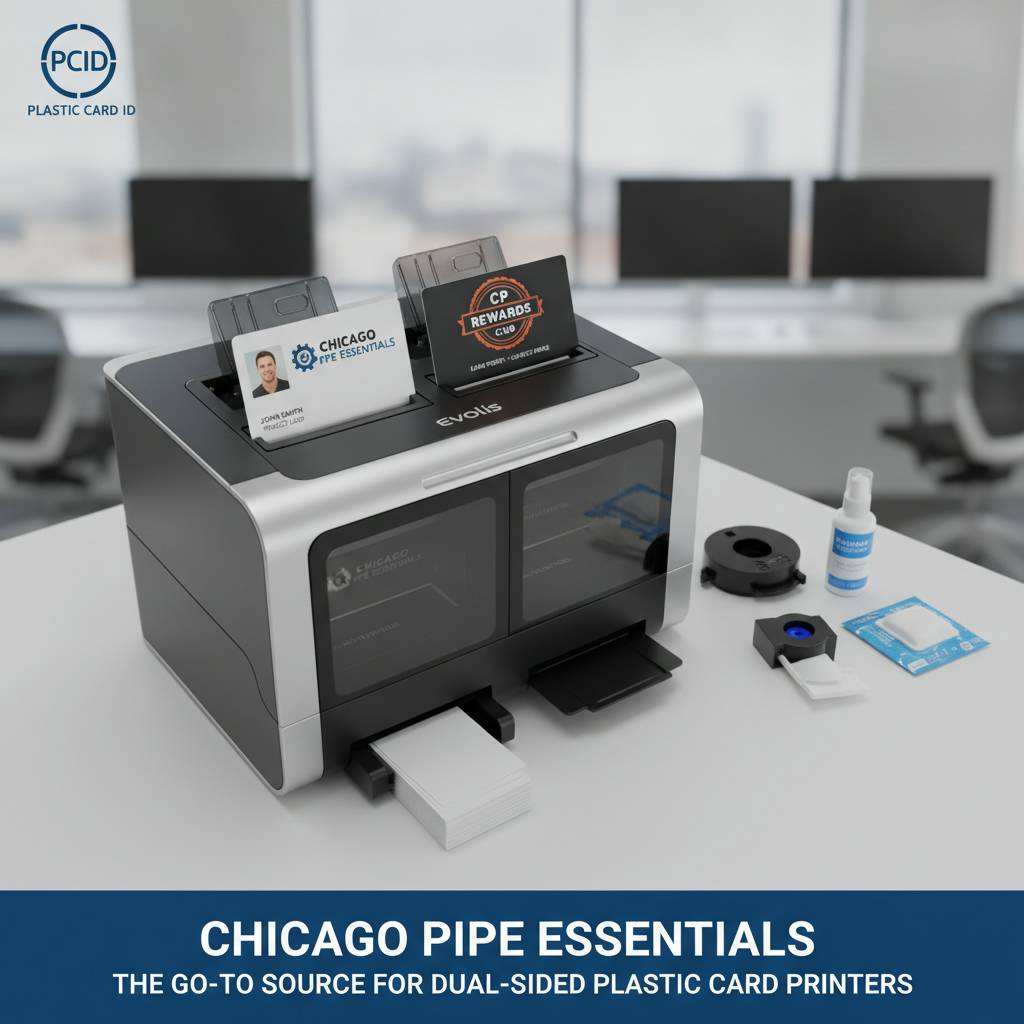 Printing both sides of a card in a single pass - that capability changes everything. Whether you're running an employee ID program, managing access control credentials, or producing membership cards that carry real information on the back, a dual-sided plastic card printer eliminates the manual flip, the alignment headaches, and the inconsistency that comes with single-pass, flip-and-reinsert workflows. The difference in professionalism is immediately visible.
Plastic Card ID has spent over 25 years supplying businesses across the United States with professional card printing hardware. With more than 100,000 customers served, their curated lineup spans every production scale - from low-volume desktop units to high-throughput industrial systems. If you need dual-sided output, they have a printer, a ribbon, and a support team ready to match your exact program requirements.
This page walks through everything worth knowing before buying: which printers handle duplex printing best, how production volume shapes the right choice, what accessories keep your program running without interruption, and what real buyers often wish they'd known before their first order.
What "Dual-Sided" Actually Means in Card Printing
A dual-sided - or duplex - card printer uses an internal retransfer or direct-to-card mechanism to print the front of a card, flip it automatically, and print the back without human intervention. This is distinct from printers that require you to manually remove, flip, and reinsert the card. The automation matters more than most buyers initially appreciate.
When both sides are handled in a single job cycle, registration stays consistent, card handling is reduced (meaning less chance of smudges or contamination), and throughput per hour stays predictable. For organizations printing hundreds of cards per month, that consistency compounds into measurable time savings and a noticeably cleaner final product.
Who Actually Needs a Duplex Printer
Not every card program demands dual-sided output. But many more do than buyers initially expect. If your card carries a magnetic stripe, signature panel, barcode, or terms and conditions language on the reverse side - you need duplex capability. If your employee IDs display a photo and name on the front with department and access level text on the back, single-sided simply won't cut it.
Organizations running hotel key card programs, student ID systems, loyalty card programs with reward tier information, and event credentials with schedule or zone data on the back all benefit from a true dual-sided printing workflow. The use cases are broader than most people initially consider when budgeting for card printing equipment.
How Plastic Card ID Supports Your Card Program From Day One
Buying a printer is the beginning, not the end. CPE supplies the full ecosystem: printer ribbons in YMCKO, monochrome, and specialty formulations; cleaning kits to maintain print head longevity; lamination modules for extra durability; encoding upgrades for magnetic stripe and smart chip; input hoppers for high-volume batch printing; and card carriers and sleeves to protect finished credentials.
That complete supply chain under one roof means your program doesn't stall waiting on ribbon orders from one vendor while your printer sits idle. Everything ships together, everything is compatible, and everything is backed by a team that has been doing this for over two decades.
| Printer Model | Brand | Volume Range | Duplex Capable | Encoding Options |
|---|---|---|---|---|
| Badgy200 | Evolis | Under 1,000 cards/year | No | Basic |
| Zenius | Evolis | 1,000-3,000 cards/month | With module | Mag stripe, smart chip |
| Primacy2 | Evolis | Up to 6,000 cards/month | Yes | Mag stripe, smart chip |
| Agilia | Evolis | High-volume premium | Yes | Full encoding suite |
| Fargo Series | Fargo | Mid to high volume | Yes | Security, mag stripe |
| Zebra Series | Zebra | Mid to high volume | Yes | Security, mag stripe |
| Matica Event Printer | Matica | High-speed on-site | Yes | Event credential focused |
Choosing the Right Dual-Sided Plastic Card Printer for Your Volume
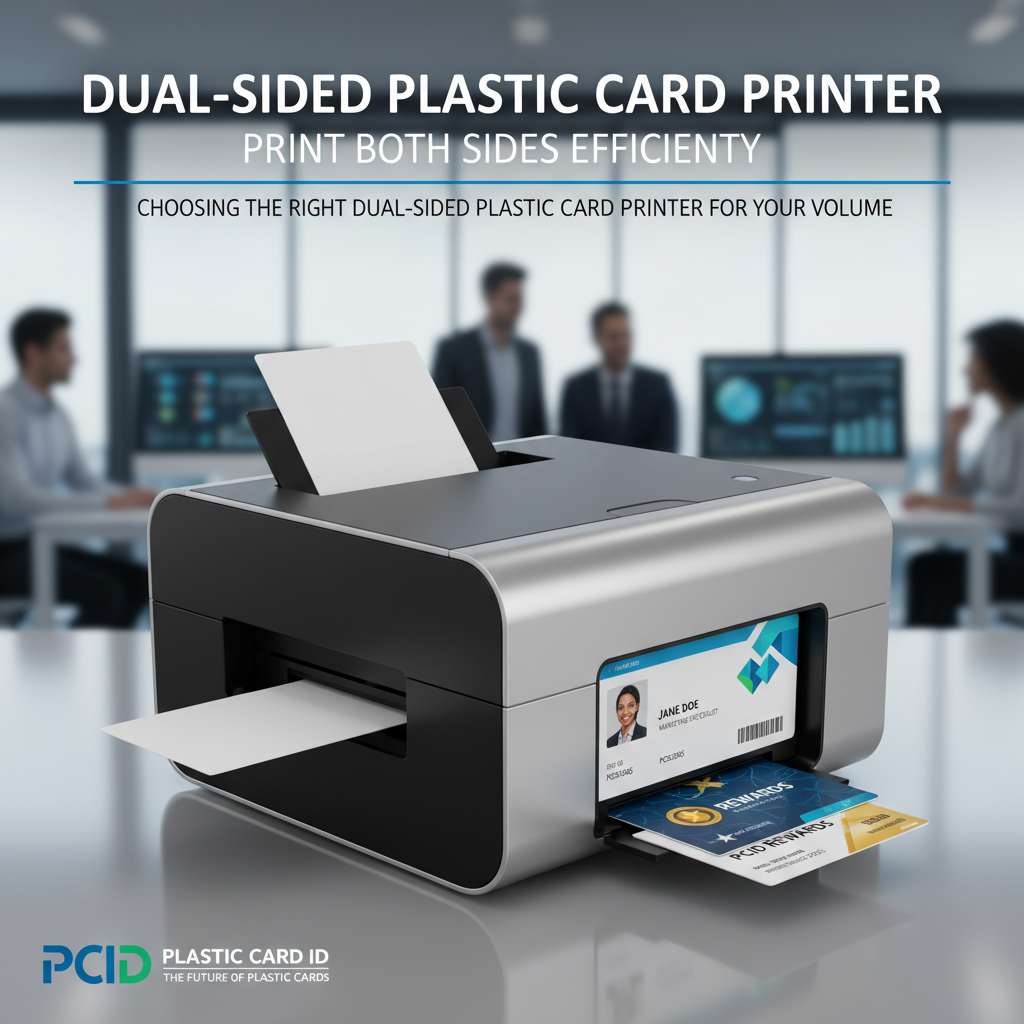 Volume is the single most important variable in selecting a card printer. A printer rated for 500 cards per month will wear out fast in a program that demands 3,000. Conversely, purchasing an industrial-grade system when you print 200 employee badges per year is a budget mismatch that serves no one. Getting the volume match right from the start saves money, time, and maintenance headaches for years.
The printers Plastic Card ID carries are organized by realistic production capacity - not marketing estimates that assume ideal conditions. The guidance below reflects real-world program demands, not spec-sheet maximums.
Entry-Level to Mid-Range: The Evolis Zenius and Primacy2
For organizations printing between 1,000 and 6,000 cards per month, the Evolis Zenius and Primacy2 represent a well-established mid-range tier. Both support dual-sided printing and magnetic stripe encoding - capabilities that immediately expand what's possible on each card. The Primacy2 in particular is a workhorse: reliable, fast, and widely used in employee ID and access control programs across a broad range of industries.
The Zenius handles lower mid-range loads efficiently and pairs well with programs that don't require batch printing of hundreds of cards per session. If your volume is moderate but your quality requirements are high - sharp photos, clean text, consistent color across every card - the Zenius and Primacy2 deliver that professional-grade output without requiring industrial-tier investment.
Premium Output: The Evolis Agilia
When the cards themselves are part of the brand experience - think premium membership credentials, VIP access cards, or high-stakes security badges - edge-to-edge, highest-quality print output becomes non-negotiable. The Evolis Agilia was built for exactly that demand. Its retransfer printing mechanism produces results that rival commercially printed cards while maintaining the on-demand flexibility of in-house production.
Dual-sided printing on the Agilia means both surfaces carry the same premium result. No compromise on the reverse side, no visible quality differential between front and back. For organizations where card quality signals organizational quality, the Agilia sets a standard that other desktop printers simply cannot match.
Security-Grade Duplex Printing: Fargo and Zebra
Fargo and Zebra printers are the established leaders in security-focused ID programs. Law enforcement, government agencies, healthcare systems, and large enterprises with strict access control requirements turn to these brands specifically because their card printers are engineered for reliability, tamper-resistance features, and integration with security software ecosystems. Both brands offer robust dual-sided printing options as part of their mid-to-high volume lineups.
If your card program involves holographic overlaminates, UV printing for anti-counterfeiting measures, or integration with access control management platforms, Fargo and Zebra printers provide the hardware backbone that those programs require. CPE carries both brands and can help match specific models to specific security program requirements. Call 800.835.7919 to discuss which security-grade duplex printer fits your organization's access control setup.
High-Speed On-Site Credentialing: The Matica Event Printer
Events are a different animal entirely. When 500 attendees need printed credentials at check-in over the course of two hours, throughput speed is the only metric that matters. The Matica Event Printer is engineered for exactly this scenario - high-speed duplex badge printing at the point of registration, with the kind of reliability that makes event managers confident rather than anxious.
Unlike office-based card programs where printing happens in batches over days or weeks, event credentialing demands consistent performance under continuous load. The Matica delivers on that demand, making it a favorite for conference organizers, trade show managers, and large-scale corporate event teams who need professional dual-sided credentials produced on the spot, at speed, without failure.
The Business Case for In-House Dual-Sided Card Printing
Outsourcing card printing to a third-party vendor feels convenient until you're waiting two weeks for a reorder because three new employees started last Monday. In-house printing eliminates that dependency entirely. You print what you need, when you need it, personalized to the individual, with encoding handled automatically as part of the print job.
The cost-per-card math also favors in-house production at meaningful volumes. Once a printer and ribbon supply are in place, the incremental cost per card drops substantially compared to outsourced unit pricing - especially when dual-sided output is factored in, since commercial printers often charge a premium for back-side printing.
Print on Demand, Personalized Every Time
One of the most underappreciated advantages of in-house dual-sided printing is true personalization at zero additional cost. Every card can carry a unique photo, name, employee number, department code, or access tier - on both sides - without the per-unit pricing that personalized outsourced orders typically carry. That flexibility is transformative for organizations managing dynamic workforces or rotating membership bases.
Variable data printing - where each card in a batch carries unique information - is standard functionality on every printer in CPE's lineup. Connect your card design software to your HR database or membership roster and print a full batch of uniquely personalized, dual-sided cards in a single automated run. No manual entry, no sorting errors, no waiting on a vendor.
Encoding on Both Sides: Magnetic Stripe and Smart Chip Integration
A dual-sided printer doesn't just print graphics on both surfaces - it can also encode functional data into the card's embedded technologies during the same print pass. Magnetic stripe encoding writes access codes, employee identifiers, or loyalty account numbers directly onto the card's mag stripe. Smart chip encoding programs contactless or contact chips with whatever data your access control or payment adjacent system requires.
These encoding steps happen automatically, in-line with the print job, eliminating a separate encoding station and the handling time that comes with it. For organizations running access control systems, hotel key programs, or student ID networks, integrated encoding during dual-sided printing is a workflow efficiency that compounds with every card produced.
Eliminating Lead Times and Vendor Dependencies
Supply chain disruptions, vendor minimums, shipping delays, and artwork revision cycles are all features of outsourced card production. In-house printing eliminates every one of them. Need 50 cards for a new cohort that starts Monday? Print them Friday afternoon. Need to update a card design because your logo changed? Update the template and print immediately, without resubmitting artwork and waiting for approval cycles.
That operational agility has real dollar value. Reduced onboarding delays, faster access provisioning, and the ability to respond to organizational changes without a card backlog - these are concrete benefits that HR teams, facilities managers, and operations directors point to when evaluating the ROI of in-house card printing programs. The printer pays for itself faster than most buyers anticipate.
Ribbons, Supplies, and Accessories That Keep Your Program Running
 A dual-sided card printer without the right ribbon supply is just hardware sitting on a desk. The consumables ecosystem around the printer - ribbons, cleaning kits, lamination modules, and input hoppers - is what makes a card program actually function at scale. Plastic Card ID supplies all of it, matched to the specific printer models they carry.
Understanding the ribbon types and their applications helps buyers plan supply budgets more accurately. It also helps avoid the common mistake of ordering the wrong ribbon for a specific print job type - a mistake that wastes both ribbon and card stock.
YMCKO vs. Monochrome Ribbons: Choosing the Right Formulation
YMCKO ribbons - Yellow, Magenta, Cyan, Black overlay, and clear Overlay panels - are the standard choice for full-color dual-sided card printing. They produce the photographic-quality color output that employee IDs, membership cards, and access credentials typically require. The K panel handles sharp black text and barcodes, while the O panel lays down a protective overlay that extends card life significantly.
Monochrome ribbons are the right choice when color isn't required - think single-color access control cards, library cards, or simple credentials where black text on a white or pre-printed card body is sufficient. Monochrome ribbons yield significantly more prints per roll than YMCKO ribbons, making them the cost-efficient choice when full-color output isn't needed. Plastic Card ID carries both formulations plus specialty ribbons for specific applications.
Cleaning Kits and Print Head Longevity
Print head replacement is the most expensive maintenance event in a card printer's life cycle. Regular cleaning - using manufacturer-specified cleaning cards and swabs - dramatically extends print head lifespan by removing dust, card debris, and ribbon residue that accumulate with every print cycle. Most printer manufacturers recommend a cleaning cycle after every ribbon change, at minimum.
Skipping cleaning cycles to save time is a false economy. A degraded print head produces streaky, inconsistent output that undermines the professional appearance dual-sided printing is supposed to deliver. Maintaining a regular cleaning schedule is the single highest-return maintenance habit in any card printing program. CPE includes cleaning kit recommendations with every printer purchase.
Lamination Modules and Input Hoppers for Scaled Operations
For organizations where card durability is paramount - outdoor access credentials, frequently handled ID cards, cards exposed to moisture or rough handling - lamination modules add a protective film layer that significantly extends card life. Laminated cards resist fading, scratching, and delamination at a level that standard overlay panels cannot match.
Input hoppers allow batch loading of blank card stock - sometimes hundreds of cards at a time - enabling unattended print runs that complete without operator intervention. Combined with dual-sided printing and in-line encoding, a printer equipped with an extended input hopper becomes a fully automated card production system that runs complete batches while staff focus on other work. Call 800.835.7919 to get a complete accessories recommendation for your specific printer model and program volume.
Frequently Asked Questions About Dual-Sided Plastic Card Printers
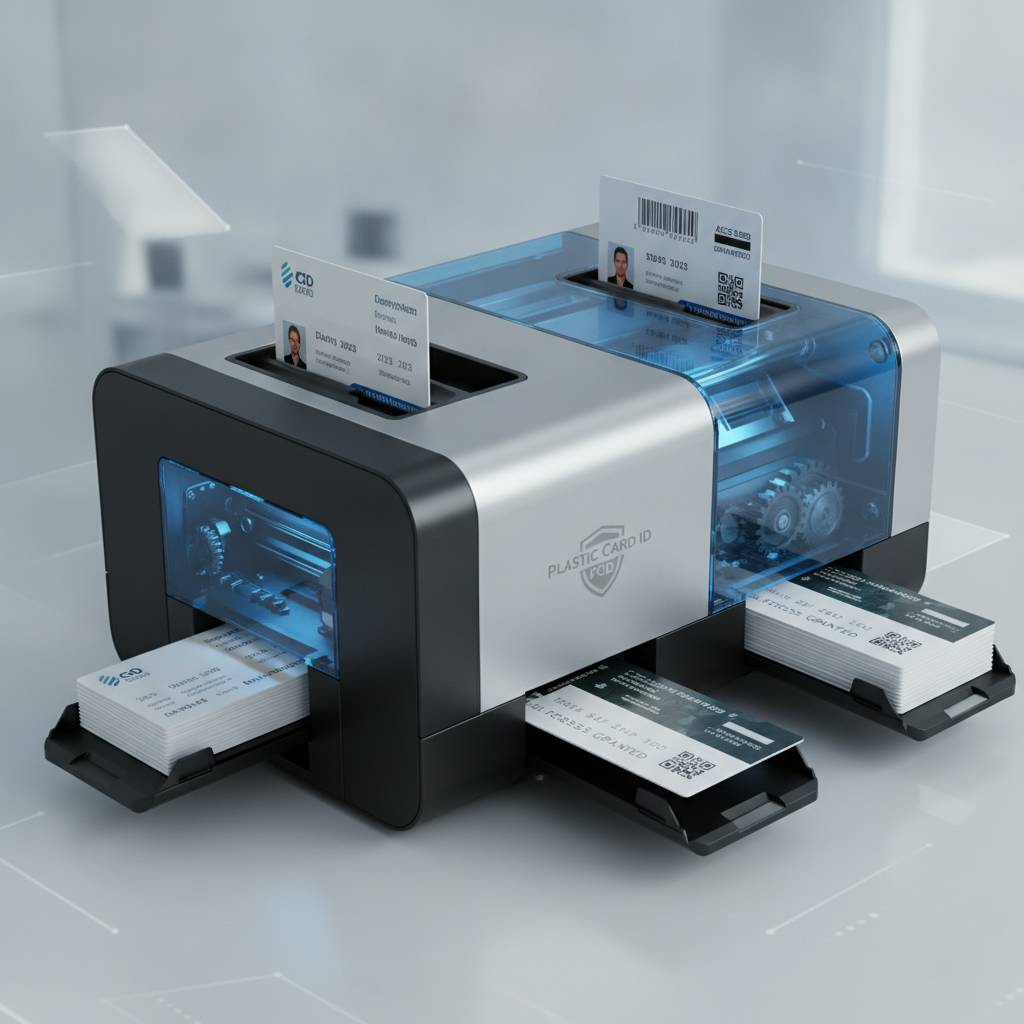 Buyers new to in-house card printing programs consistently ask the same core questions before making a purchase decision. The answers below reflect the real-world guidance CPE provides to customers across industries, production scales, and program types.
What Is the Difference Between Direct-to-Card and Retransfer Dual-Sided Printing?
Direct-to-card (DTC) printing applies dye-sublimation ink directly to the card surface. It's fast, cost-effective, and produces excellent results for most standard ID card applications. Retransfer printing applies the image to a clear film first, which is then bonded to the card surface - resulting in edge-to-edge coverage and a visibly superior finish, especially on smart cards and access control cards where the card surface is uneven.
For most mid-range programs - employee IDs, membership cards, student credentials - direct-to-card dual-sided printing delivers excellent results at a lower cost per print. When print quality is the priority above all else, retransfer technology like that used in the Evolis Agilia represents the premium tier of dual-sided card production.
How Do I Know What Volume My Program Actually Requires?
Start with total headcount and card turnover rate. An organization with 200 employees that issues new cards annually and processes 50 new hires per year has a modest volume - around 250 cards per year. Add replacement cards (typically 10-15% of total issued cards annually), visitor badges, and temporary credentials, and your real annual volume emerges. Most buyers underestimate replacements and temporary credentials when doing this math.
- Count current total cardholders in your program
- Estimate annual new issuances (new hires, new members, new students)
- Add 10-15% for replacement cards
- Include visitor, contractor, or temporary credential volume
- Add 20% buffer for growth and unexpected demand spikes
- Match that total annual figure to the appropriate printer tier
This six-step volume calculation prevents both under-buying and over-buying - the two most common and expensive mistakes first-time card printer buyers make. CPE walks every customer through this exercise before recommending a specific model.
Can I Upgrade a Single-Sided Printer to Dual-Sided Later?
Some printers - including select Evolis models - support a duplex module upgrade that can be added after initial purchase. This is a genuine advantage for organizations that start with a single-sided workflow and later discover they need back-side printing as their program matures. Not all models support this upgrade path, however, so it's worth clarifying before purchase if future dual-sided capability is a possibility.
Buyers who anticipate needing dual-sided output within 12-24 months are generally better served by purchasing a duplex-capable model upfront, even if they don't immediately use the back-side printing capability. The cost differential at purchase time is smaller than the cost of replacing a printer that can't be upgraded.
Card Programs That Benefit Most From Dual-Sided Printing
The range of organizations running in-house dual-sided card programs is broader than many buyers realize. From small businesses issuing employee IDs to large universities managing student credential systems, the use cases share a common thread: both sides of the card carry information that matters, and that information needs to look professional.
Plastic Card ID serves customers across every one of these program types, with printer recommendations, ribbon supply planning, and accessory configurations tailored to each specific application.
Employee ID and Access Control Programs
Employee ID cards almost universally benefit from dual-sided printing. The front carries the employee photo, name, title, and company branding. The back carries the magnetic stripe or smart chip encoding for door access, a barcode for time and attendance systems, emergency contact information, or terms of use language required by security policy. Single-sided employee IDs leave valuable card real estate unused - and often force organizations to attach supplementary labels or inserts that look unprofessional.
Access control cards in particular demand dual-sided output because the encoding requirements and the identification requirements both need to be present on the same credential. A card that grants building access but doesn't visually identify the bearer is a security gap. A card that identifies the bearer but can't be read by the access control reader is a convenience failure. Dual-sided printing with integrated encoding solves both simultaneously.
Membership, Loyalty, and Student ID Programs
Membership cards carry brand identity on the front and program details - account numbers, tier levels, terms of membership, or contact information - on the back. Loyalty cards follow the same pattern, often with a barcode or magnetic stripe on the reverse side that integrates with point-of-sale systems. Both program types depend on the back of the card being as functional as the front.
Student IDs represent one of the highest-volume dual-sided use cases in institutional settings. University and school programs issue thousands of cards per year, with front-side photo identification and back-side library access, meal plan encoding, building access programming, and emergency information all carried on a single credential. The Evolis Primacy2 and Fargo series are particularly well-suited to this application scale.
Hotel Key Cards and Event Credentials
Hotel key cards are a specialized dual-sided application where the front carries branding and room assignment information while the back carries the magnetic stripe or contactless chip that programs the lock. In-house printing for hotel programs means room assignments can be encoded and printed at check-in, on demand, without pre-printed card stock with fixed room numbers. That flexibility is operationally significant for properties with dynamic room assignment workflows.
Event credentials - conference badges, trade show passes, festival wristbands - benefit from dual-sided printing when schedule information, zone access designations, or sponsor branding needs to appear on the reverse side. The Matica Event Printer handles this use case at the throughput speeds that busy registration desks demand, producing professional dual-sided credentials at a pace that keeps check-in lines moving.
Work With Plastic Card ID to Build Your Dual-Sided Card Printing Program
 Twenty-five years of experience and over 100,000 customers means CPE has seen virtually every card program configuration imaginable - and helped organizations across every industry find the right printer, ribbon, and accessory combination for their specific needs. That depth of experience translates directly into better buying decisions for new customers.
The printer lineup Plastic Card ID carries - Evolis, Fargo, Zebra, and Matica - represents the industry's most trusted brands, selected specifically because they perform reliably across real-world production environments. These aren't consumer-grade devices dressed up in professional packaging. They are purpose-built professional tools for organizations that take their card programs seriously.
Getting the Right Recommendation for Your Program
The right dual-sided plastic card printer depends on your volume, your encoding requirements, your print quality expectations, and your budget. No single model is the right answer for every organization. Plastic Card ID takes the time to understand where your program is today and where it's likely to go over the next few years before making a recommendation - because a printer that fits your current needs but can't scale with your growth is a problem deferred, not solved.
Whether you're setting up a card program from scratch, replacing aging equipment, or expanding an existing system to include dual-sided capability, the expertise and inventory depth at CPE makes the process straightforward. The goal is always a card program that runs smoothly, produces professional results, and costs less per card than outsourcing - from day one forward.
Complete Supply Support Beyond the Initial Purchase
A card program is an ongoing operation, not a one-time purchase. Ribbons deplete, cleaning kits need restocking, encoding modules occasionally need servicing, and as programs grow, additional hardware may be needed. Plastic Card ID supports customers through the full lifecycle of their card programs - not just at the point of initial sale.
That continuity of supply and support is what distinguishes a dedicated card printer specialist from a general hardware reseller. When your ribbon runs out on a Tuesday morning with 200 cards to print before an event on Thursday, having a supplier relationship already in place - with compatible consumables in stock and ready to ship - is exactly the kind of operational reliability that keeps your card program running without interruption. Contact Plastic Card ID directly at 800.835.7919 to discuss your dual-sided printing needs and get a complete program recommendation tailored to your organization.
Ready to Get Started?
Call Plastic Card ID today at 800.835.7919 and speak directly with a card printing specialist who can match your dual-sided printing requirements to the right printer, ribbon, and accessory configuration - so your program launches right and runs reliably for years to come.
Plastic Card ID - your trusted source for professional dual-sided plastic card printers, supplies, and program expertise. Reach us at 800.835.7919 and let's build your card program the right way.
Previous Page